
The Pillars of Reading: Understanding the Foundations of Strong Literacy Skills
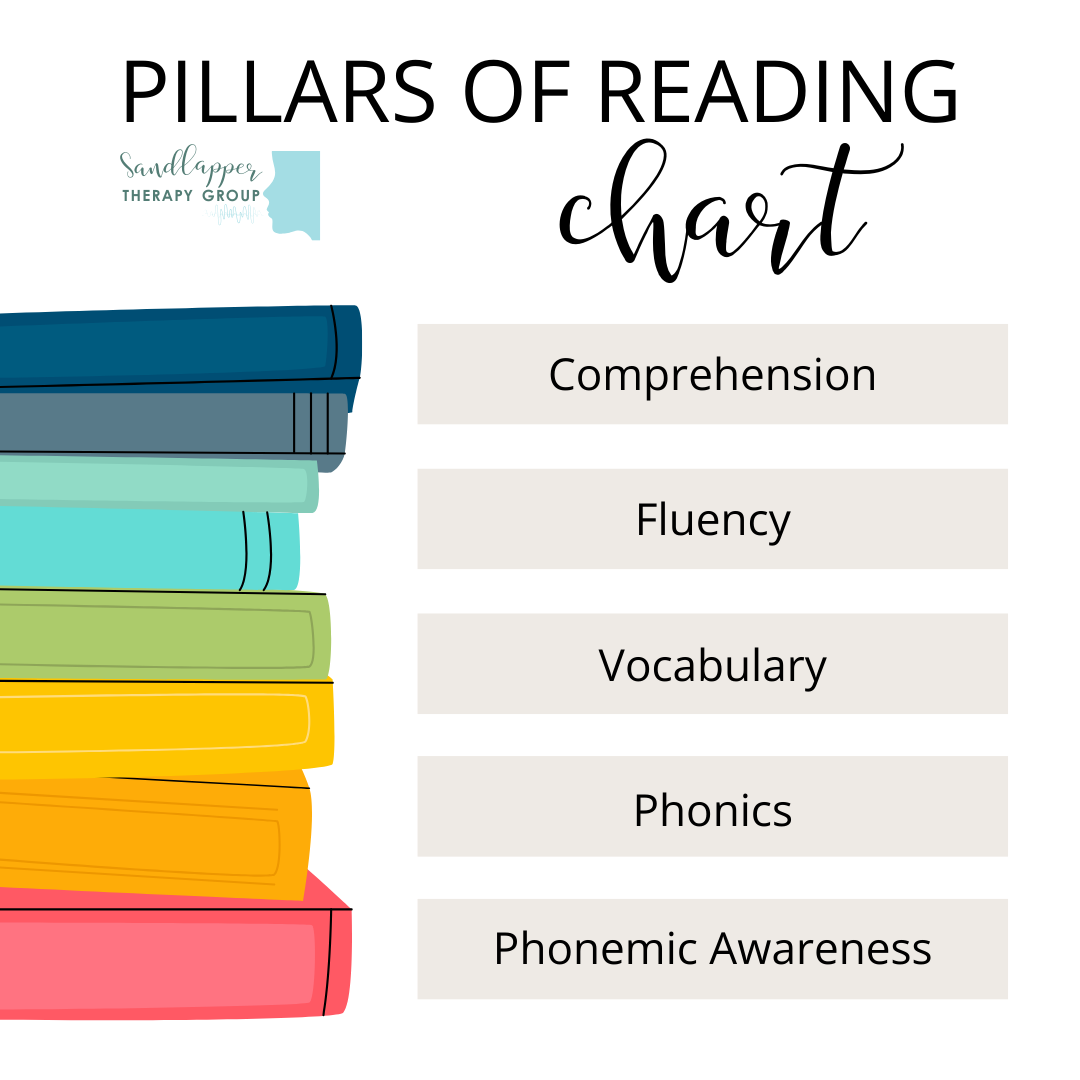
Learning to read is one of the most important milestones in a child’s academic journey. Reading success doesn’t happen by accident — it is built on a foundation of interconnected skills often referred to as the five pillars of reading:
Phonemic Awareness
Phonics
Vocabulary
Fluency
Comprehension
These pillars are supported by decades of research, including findings from the National Reading Panel and guidance from the American Speech-Language-Hearing Association (ASHA).
👉 https://www.asha.org/public/speech/development/literacy/
If one pillar is weak, reading development can become unstable. Let’s break down each component and explain how speech-language therapy supports literacy development.
1️⃣ Phonemic Awareness
Phonemic awareness is the ability to hear and manipulate individual sounds (phonemes) in spoken words.
Examples:
Identifying the first sound in “cat”
Blending sounds: /c/ /a/ /t/
Segmenting sounds in “dog”
This skill is auditory — it does not involve letters yet.
Why it matters:
Phonemic awareness is one of the strongest predictors of early reading success. Research shows that explicit instruction in phonemic awareness significantly improves reading outcomes (National Reading Panel, 2000).
Children with speech or language delays are at higher risk for phonological awareness difficulties.
2️⃣ Phonics
Phonics connects sounds to letters.
Examples:
Knowing that “b” makes the /b/ sound
Reading simple CVC words (cat, dog, hat)
Understanding vowel teams (ea, ai)
Phonics instruction teaches decoding — the ability to read unfamiliar words.
ASHA emphasizes that speech sound development and phonics are closely related, as accurate speech sound knowledge supports decoding skills.
👉 https://www.asha.org/practice-portal/clinical-topics/spoken-language-disorders/
3️⃣ Vocabulary
Vocabulary refers to the words a child understands and uses.
There are two types:
Receptive vocabulary (words understood)
Expressive vocabulary (words spoken)
Strong vocabulary supports reading comprehension and academic success. According to research, vocabulary knowledge in early childhood predicts later reading comprehension ability (Stahl & Nagy, 2006).
Children with limited vocabulary may decode words accurately but still struggle to understand what they read.
4️⃣ Fluency
Fluency is the ability to read smoothly, accurately, and with expression.
Fluent readers:
Recognize words automatically
Read at an appropriate rate
Use natural phrasing
Fluency bridges decoding and comprehension. If too much effort is spent decoding, comprehension suffers.
5️⃣ Comprehension
Comprehension is the ultimate goal of reading — understanding what is read.
It involves:
Making predictions
Answering questions
Identifying main ideas
Making inferences
Connecting text to background knowledge
ASHA notes that language comprehension skills are foundational to reading comprehension development.
👉 https://www.asha.org/public/speech/development/language/
How Speech Therapy Supports Reading Skills
Speech-language pathologists play a critical role in literacy development because reading is fundamentally a language-based skill.
SLPs target:
Phonological awareness
Speech sound production
Vocabulary expansion
Sentence structure
Narrative skills
Listening comprehension
Children with Developmental Language Disorder (DLD), speech sound disorders, or auditory processing challenges are at increased risk for reading difficulties.
Early intervention significantly improves outcomes.
Warning Signs of Reading Difficulties
Consider seeking evaluation if your child:
Struggles to rhyme
Cannot blend or segment sounds
Has difficulty learning letter-sound relationships
Reads slowly and inaccurately
Avoids reading
Struggles to retell stories
The International Dyslexia Association provides additional information about early literacy warning signs:
👉 https://dyslexiaida.org/
Why Early Support Matters
Research consistently shows that early identification and structured literacy instruction improve long-term reading success (National Reading Panel, 2000).
The earlier intervention begins, the more effectively we can strengthen the reading foundation.
How Parents Can Support the Pillars at Home
✔ Read aloud daily
✔ Play rhyming and sound games
✔ Practice letter-sound correspondence
✔ Teach new vocabulary intentionally
✔ Ask comprehension questions during story time
Building all five pillars together ensures balanced literacy development.
Final Thoughts
Reading is not a single skill — it is built on five essential pillars:
Phonemic Awareness
Phonics
Vocabulary
Fluency
Comprehension
When these pillars are strong, children become confident, capable readers.
If your child is struggling with reading or early literacy skills, speech therapy can provide targeted, evidence-based support.
Contact our office today to schedule a literacy-focused speech and language evaluation.
References
American Speech-Language-Hearing Association (ASHA). (2024). Literacy and Language Development. Retrieved from https://www.asha.org
American Speech-Language-Hearing Association (ASHA). (2024). Spoken Language Disorders Practice Portal. Retrieved from https://www.asha.org/practice-portal/clinical-topics/spoken-language-disorders/
National Reading Panel. (2000). Teaching Children to Read: An Evidence-Based Assessment of the Scientific Research Literature on Reading and Its Implications for Reading Instruction.
Stahl, S. A., & Nagy, W. E. (2006). Teaching Word Meanings. Lawrence Erlbaum Associates.
International Dyslexia Association. (2023). Early Warning Signs of Dyslexia. Retrieved from https://dyslexiaida.org