
Play Skills Hierarchy: How Play Develops from Birth to Preschool
Play is more than fun — it is the foundation of communication, language development, and social skills. In speech therapy, we often reference the play skills hierarchy to understand how children develop interaction, imagination, and cooperative communication.
Play follows a predictable progression from infancy through early childhood. When children struggle with language or social development, we often see gaps in play skills as well.
According to the American Speech-Language-Hearing Association (ASHA), play is directly connected to speech, language, social communication, and cognitive development.
👉 https://www.asha.org/public/speech/development/play/
Let’s walk through the stages of play development and why they matter.
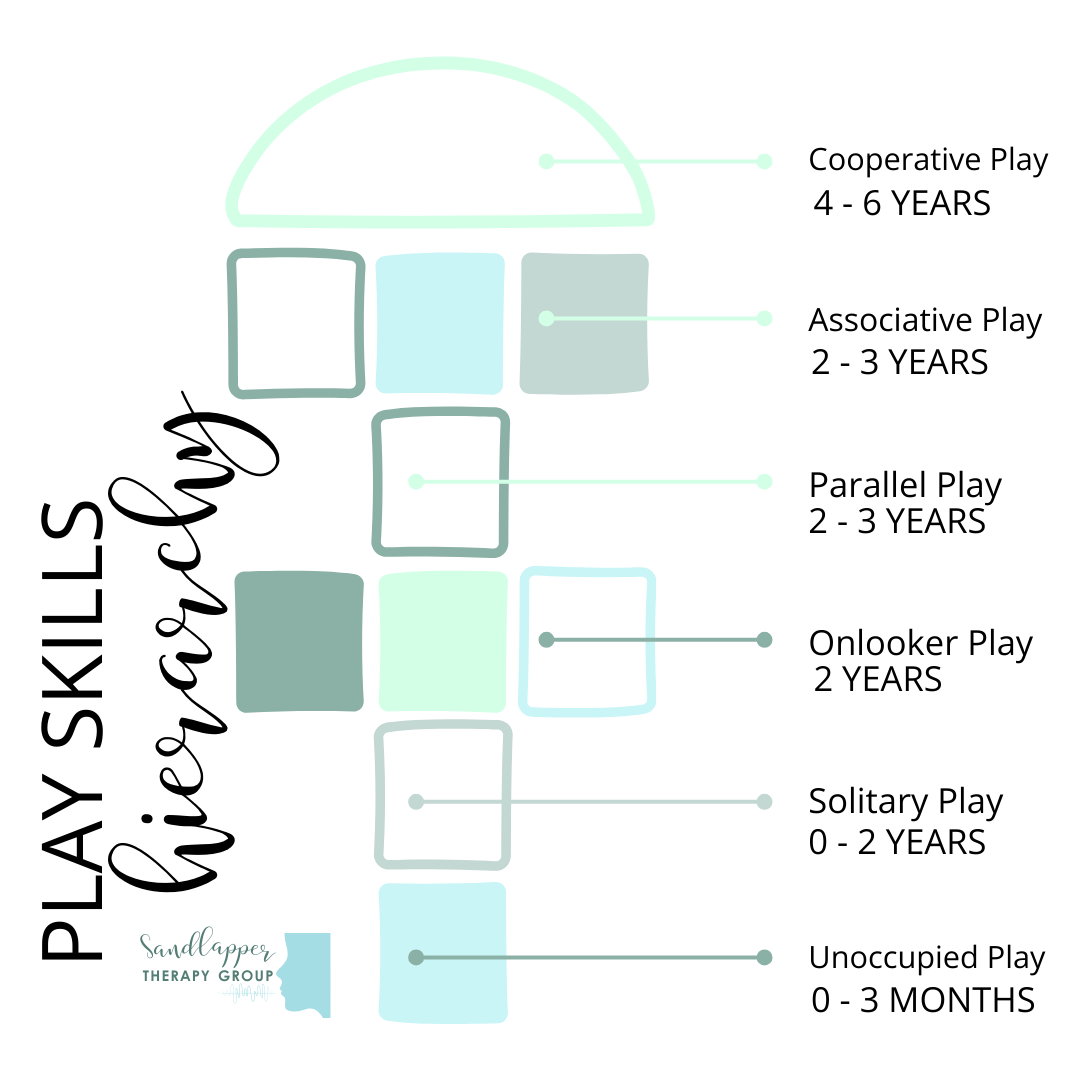
The Play Skills Hierarchy
1️⃣ Unoccupied Play (0–3 Months)
At this earliest stage, infants are not actively “playing” in a traditional sense. Instead, they:
Move their arms and legs
Observe surroundings
Track objects with their eyes
Explore sensory experiences
This stage builds early attention and sensory regulation — critical foundations for later engagement.
2️⃣ Solitary Play (0–2 Years)
Toddlers begin playing independently. They:
Explore toys alone
Focus on their own activity
Show limited awareness of peers
Solitary play helps children develop:
Problem-solving skills
Attention span
Early cause-and-effect understanding
While children may be near others, they are not yet interacting socially.
3️⃣ Onlooker Play (Around 2 Years)
Children begin watching other children play. They may:
Observe peers closely
Ask questions
Imitate after watching
Onlooker play is a bridge between independent play and social interaction. It demonstrates emerging social interest and learning through observation.
4️⃣ Parallel Play (2–3 Years)
In parallel play, children play next to each other but not directly with each other.
Examples:
Two toddlers building blocks side-by-side
Playing with similar toys without shared goals
This stage is critical for:
Learning turn-taking
Developing awareness of peers
Building social comfort
Parallel play is very common in toddlers and is developmentally appropriate.
5️⃣ Associative Play (2–3 Years)
Children begin interacting during play but may not yet share a structured goal.
They may:
Share toys
Talk during play
Borrow materials
Imitate one another
This stage supports conversational skills and joint attention — both essential for language development.
6️⃣ Cooperative Play (4–6 Years)
At this advanced stage, children:
Play with shared goals
Assign roles (“You be the teacher, I’ll be the student.”)
Follow rules
Problem-solve together
Cooperative play requires:
Strong language skills
Perspective-taking
Executive functioning
Emotional regulation
This stage prepares children for classroom learning and peer collaboration.
Why Play Matters for Speech & Language Development
Play is the context in which children learn language naturally. During play, children practice:
Vocabulary
Sentence structure
Turn-taking
Narrative skills
Social problem-solving
Research consistently shows that symbolic and pretend play are strongly associated with later language development (Lillard et al., 2013).
ASHA emphasizes that social communication skills develop through play-based interactions.
👉 https://www.asha.org/practice-portal/clinical-topics/social-communication-disorder/
Signs a Child May Need Support with Play Skills
Consider a speech-language evaluation if your child:
Does not engage in pretend play by age 2–3
Rarely imitates actions or sounds
Avoids peer interaction
Has difficulty sharing or taking turns
Plays repetitively without variation
Does not engage in cooperative play by preschool
Delays in play skills are often seen in children with:
Developmental Language Disorder (DLD)
Autism Spectrum Disorder (ASD)
Social Communication Disorder
Speech delays
How Speech Therapy Supports Play Development
Speech-language pathologists use play-based therapy to:
Teach imitation skills
Build joint attention
Expand vocabulary
Develop pretend play
Practice conversational turns
Improve social problem-solving
Play-based intervention is evidence-supported for improving language outcomes in young children (Roberts & Kaiser, 2011).
How Parents Can Support Play Skills at Home
✔ Get on the floor and follow your child’s lead
✔ Model pretend play scenarios
✔ Narrate actions during play
✔ Encourage turn-taking games
✔ Set up play dates with structured support
✔ Reduce screen time to encourage interactive play
The CDC’s Learn the Signs. Act Early. program highlights play as a key developmental milestone indicator.
👉 https://www.cdc.gov/ncbddd/actearly/
Final Thoughts
Play is not just entertainment — it is the engine of language, social, and cognitive development.
From unoccupied play in infancy to cooperative play in preschool, each stage builds the foundation for communication and academic readiness.
If your child is struggling with play skills or social interaction, early speech therapy intervention can provide meaningful support.
Contact our office today to schedule a developmental speech and language evaluation.
References
American Speech-Language-Hearing Association (ASHA). (2024). Play and Language Development. Retrieved from https://www.asha.org
American Speech-Language-Hearing Association (ASHA). (2024). Social Communication Disorder Practice Portal. Retrieved from https://www.asha.org/practice-portal/clinical-topics/social-communication-disorder/
Centers for Disease Control and Prevention (CDC). (2023). Learn the Signs. Act Early. Retrieved from https://www.cdc.gov/ncbddd/actearly
Lillard, A. S., et al. (2013). The impact of pretend play on children’s development: A review of the evidence. Psychological Bulletin.
Roberts, M. Y., & Kaiser, A. P. (2011). The effectiveness of parent-implemented language interventions. American Journal of Speech-Language Pathology.