
Following Directions Hierarchy in Speech Therapy: From One-Step to Complex Multi-Step
Following directions is a foundational receptive language skill that impacts classroom success, behavior, social communication, and independence.
In speech therapy, we often use a following directions hierarchy to systematically build comprehension skills from simple to complex.
If your child struggles to follow instructions like “Put your shoes away and grab your backpack,” understanding this hierarchy can help explain why — and what to do next.
According to the American Speech-Language-Hearing Association (ASHA), receptive language skills — including the ability to follow directions — are essential for academic achievement and daily functioning.
👉 https://www.asha.org/public/speech/development/language/
Why Following Directions Matters
Children use this skill to:
Complete classroom tasks
Participate in group activities
Follow safety rules
Manage routines independently
Understand stories and explanations
Difficulty following directions may affect reading comprehension, executive functioning, and behavior.
The Following Directions Hierarchy
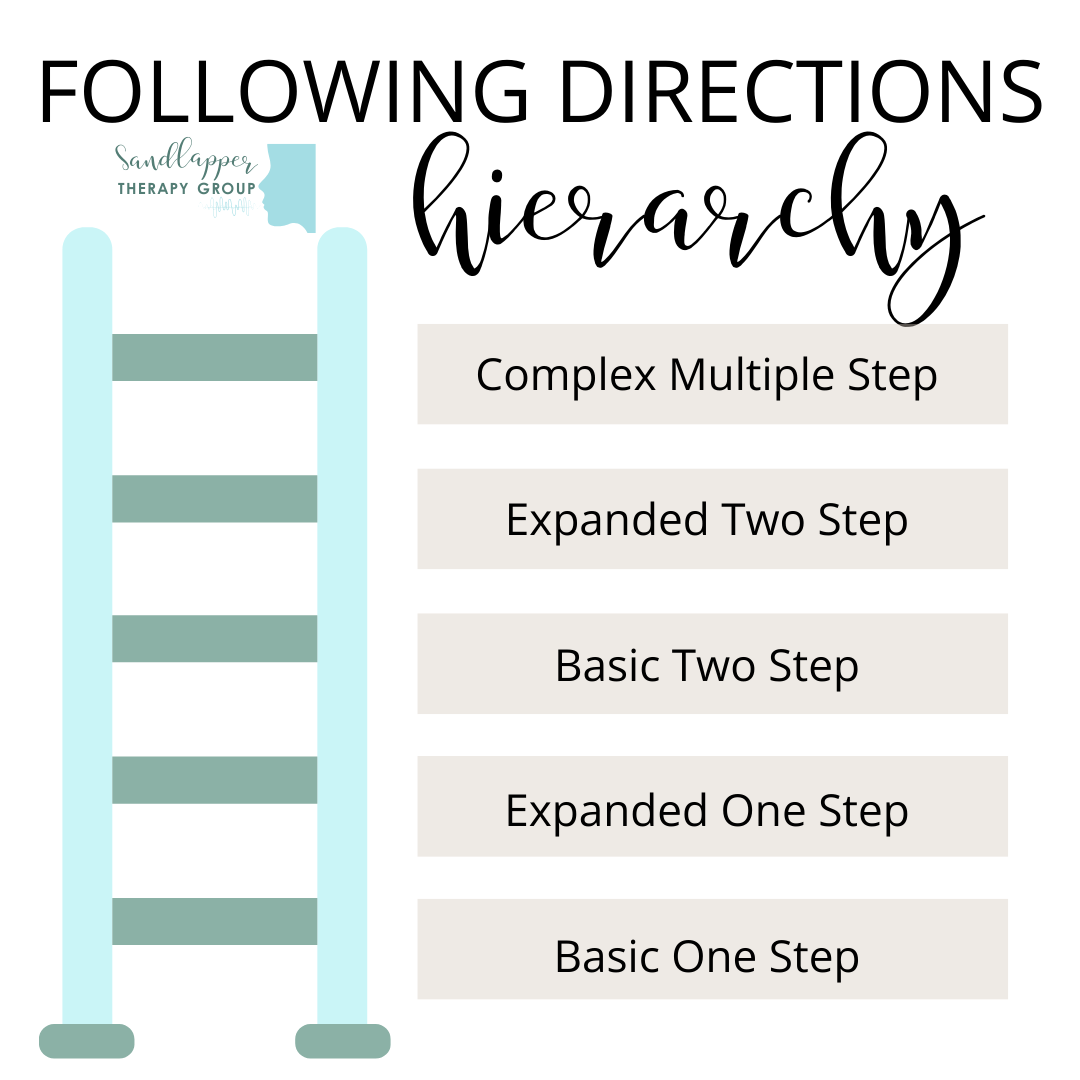
Speech-language pathologists typically progress through structured levels:
1️⃣ Basic One-Step Directions
These directions involve one action and minimal language complexity.
Examples:
“Sit down.”
“Give me the ball.”
“Clap your hands.”
At this stage, children rely heavily on context and visual cues.
2️⃣ Expanded One-Step Directions
Still one action — but with added descriptive language.
Examples:
“Give me the red ball.”
“Put the big block on the table.”
“Touch your nose with your finger.”
Now the child must process adjectives, prepositions, or additional details.
3️⃣ Basic Two-Step Directions
Two sequential actions without added modifiers.
Examples:
“Pick up the toy and put it away.”
“Stand up and clap.”
This level requires memory and sequencing skills.
4️⃣ Expanded Two-Step Directions
Two actions with added descriptive or spatial information.
Examples:
“Pick up the blue crayon and put it in the box.”
“Touch your head and then stomp your feet.”
Children must process:
Sequence words (first, then)
Descriptors
Location concepts
5️⃣ Complex Multi-Step Directions
Three or more steps and increased linguistic complexity.
Examples:
“Before you sit down, put your folder on the desk and take out your pencil.”
“Grab your coat, line up by the door, and wait quietly.”
These directions often include:
Temporal concepts (before, after)
Conditional language (if, when)
Negation (don’t, except)
Embedded clauses
This level heavily involves executive functioning and working memory.
Developmental Expectations
While there is variability, general trends suggest:
Toddlers follow simple one-step directions.
Preschoolers follow two-step directions.
Early elementary students manage multi-step directions with modifiers.
The CDC developmental milestones emphasize that by age 2, children typically follow simple directions, and by age 4–5, they can follow multi-step classroom instructions.
👉 https://www.cdc.gov/ncbddd/actearly/
What Skills Are Required to Follow Directions?
Following directions involves more than listening. It requires:
Receptive vocabulary
Auditory processing
Working memory
Attention
Sequencing
Executive functioning
ASHA’s Practice Portal on spoken language disorders explains how receptive language difficulties may impact comprehension of directions.
👉 https://www.asha.org/practice-portal/clinical-topics/spoken-language-disorders/
Signs a Child May Need Support
Consider a speech-language evaluation if your child:
Frequently says “What?” or needs repetition
Completes only part of a direction
Appears inattentive but is actually confused
Struggles with multi-step instructions
Has difficulty in structured classroom tasks
Challenges with following directions are common in children with:
Developmental Language Disorder (DLD)
ADHD
Auditory processing difficulties
Autism spectrum disorder
Evidence-Based Strategies to Improve Direction Following
Research supports explicit instruction and scaffolded language practice to improve comprehension skills (Gillam & Gillam, 2016).
✔ Start Simple and Build Up
Follow the hierarchy. Master one level before increasing complexity.
✔ Reduce Visual Clutter
Minimize distractions to support auditory focus.
✔ Use Visual Supports
Visual schedules and gestures reinforce comprehension.
✔ Teach Key Vocabulary
Explicitly teach words like before, after, between, and except.
✔ Check for Understanding
Ask the child to repeat the direction or explain what they will do.
Classroom & Home Tips
At home:
Practice two-step routines (“Get your pajamas and brush your teeth.”)
Use cooking or craft activities for sequencing practice
Play games like “Simon Says”
In school:
Provide written and visual cues
Break longer instructions into smaller parts
Allow processing time
Why Early Intervention Matters
Following directions is strongly linked to:
Reading comprehension
Writing organization
Task completion
Academic success
Children who struggle with receptive language benefit from early, targeted speech therapy intervention.
Final Thoughts
Following directions develops in stages — from basic one-step commands to complex multi-step instructions involving time concepts and sequencing.
If your child struggles with comprehension, it is not a behavior problem — it may be a language processing challenge.
A comprehensive speech-language evaluation can identify specific areas of need and provide targeted intervention strategies.
Contact our office today to support your child’s receptive language and academic readiness.
References
American Speech-Language-Hearing Association (ASHA). (2024). Language Development. Retrieved from https://www.asha.org
American Speech-Language-Hearing Association (ASHA). (2024). Spoken Language Disorders Practice Portal. Retrieved from https://www.asha.org/practice-portal/clinical-topics/spoken-language-disorders/
Centers for Disease Control and Prevention (CDC). (2023). Learn the Signs. Act Early. Retrieved from https://www.cdc.gov/ncbddd/actearly
Gillam, S. L., & Gillam, R. B. (2016). Narrative discourse intervention for school-aged children with language impairment. Topics in Language Disorders.