
Stuttering Risk Factors: What Parents Need to Know
Stuttering is common in early childhood, especially between ages 2 and 5 when language is rapidly developing. While many children outgrow stuttering, some are at greater risk for persistent stuttering.
Understanding stuttering risk factors can help families know when to monitor and when to seek speech therapy.
According to the American Speech-Language-Hearing Association (ASHA), early identification of fluency disorders improves long-term outcomes.
👉 https://www.asha.org/public/speech/disorders/stuttering/
Below, we’ll review the most recognized risk factors for persistent stuttering, from least to greatest concern.
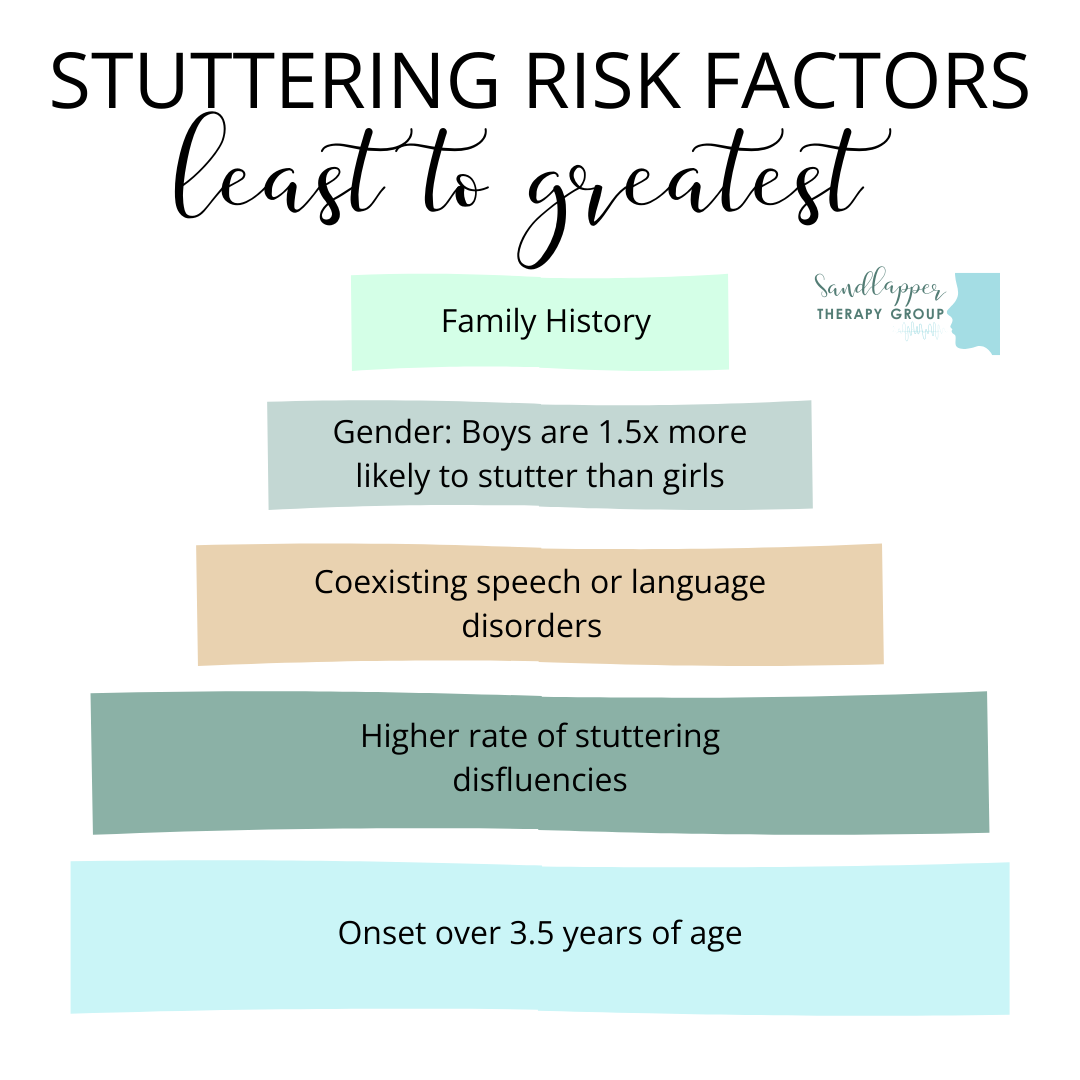
Key Stuttering Risk Factors
1️⃣ Family History
A family history of stuttering is one of the strongest predictors of persistence.
Research shows that children with relatives who stutter are significantly more likely to continue stuttering beyond early childhood (Yairi & Ambrose, 2013).
Important considerations:
Was the family member’s stuttering persistent into adulthood?
Did they require therapy?
Did they recover naturally?
Genetics play a meaningful role in fluency disorders.
2️⃣ Gender
Boys are approximately 1.5 times more likely to stutter than girls in early childhood.
Over time, the ratio increases, with boys being even more likely to experience persistent stuttering.
ASHA notes that gender is an important factor when evaluating risk for chronic stuttering.
👉 https://www.asha.org/practice-portal/clinical-topics/fluency-disorders/
3️⃣ Coexisting Speech or Language Disorders
Children who have:
Speech sound disorders
Developmental language disorder (DLD)
Delayed language skills
may be at higher risk for persistent stuttering.
When speech and language systems are already under strain, fluency challenges can become more complex.
Research supports that children with co-occurring communication disorders are more likely to experience ongoing fluency difficulties (Ntourou et al., 2011).
4️⃣ Higher Rate of Stuttering-Like Disfluencies
Not all disfluencies are equal.
Stuttering-like disfluencies include:
Sound repetitions (b-b-ball)
Prolongations (ssssun)
Blocks (no sound coming out)
A higher frequency of these disfluencies, especially accompanied by tension or struggle, increases concern.
Other warning signs include:
Physical tension
Facial grimacing
Avoidance behaviors
Frustration when speaking
5️⃣ Onset After 3½ Years of Age
Children who begin stuttering after age 3½ are at higher risk for persistence compared to those who begin earlier.
Most developmental stuttering begins between 2–3½ years. Later onset may signal increased risk for chronic stuttering (Yairi & Ambrose, 2013).
Additional Risk Factors to Consider
Beyond those shown above, clinicians also look at:
Stuttering lasting longer than 6–12 months
Increasing severity over time
Negative emotional reactions to speaking
Lack of improvement
Avoidance of certain words or situations
The National Institute on Deafness and Other Communication Disorders (NIDCD) also highlights the importance of duration and family history in determining persistence.
👉 https://www.nidcd.nih.gov/health/stuttering
Why Early Evaluation Matters
While many children outgrow stuttering, it is impossible to predict with certainty who will recover naturally.
Early speech-language evaluation can:
Identify risk factors
Provide monitoring guidance
Offer prevention strategies
Begin early intervention if needed
ASHA recommends early assessment when risk factors are present.
👉 https://www.asha.org/public/speech/disorders/stuttering/
Evidence-Based Treatment for Stuttering
Research-supported treatments include:
✔ The Lidcombe Program
A parent-implemented behavioral treatment with strong evidence for preschool children (Onslow et al., 2003).
✔ Fluency Shaping Therapy
Teaches strategies to improve speech flow.
✔ Stuttering Modification Therapy
Focuses on reducing tension and managing moments of stuttering.
✔ Cognitive-Behavioral Therapy (CBT)
Addresses anxiety and emotional impacts in older children.
Early intervention is associated with:
Reduced severity
Lower emotional distress
Improved confidence
Better long-term outcomes
When to Schedule a Speech Evaluation
Consider scheduling an evaluation if your child:
Has multiple risk factors
Has been stuttering for more than 6 months
Shows physical tension when speaking
Avoids talking
Has a family history of persistent stuttering
Began stuttering after age 3½
Even if therapy is not immediately recommended, monitoring with a speech-language pathologist provides clarity and peace of mind.
Supporting Your Child at Home
Parents can help by:
Modeling slow, relaxed speech
Maintaining eye contact during stuttering
Avoiding “slow down” reminders
Reducing communication pressure
Validating feelings
The National Stuttering Association provides additional family support resources.
👉 https://westutter.org/
Final Thoughts
Stuttering is common — but risk factors matter.
The strongest predictors of persistent stuttering include:
Family history
Male gender
Coexisting speech/language disorders
Higher frequency of stuttering-like disfluencies
Onset after 3½ years
If you are unsure whether your child’s stuttering is developmental or persistent, early evaluation is the best next step.
Our speech-language pathologists provide evidence-based stuttering therapy tailored to each child’s needs. Contact us today to schedule a consultation.
References
American Speech-Language-Hearing Association (ASHA). (2024). Stuttering (Fluency Disorder). Retrieved from https://www.asha.org/public/speech/disorders/stuttering/
American Speech-Language-Hearing Association (ASHA). (2024). Fluency Disorders Practice Portal. Retrieved from https://www.asha.org/practice-portal/clinical-topics/fluency-disorders/
National Institute on Deafness and Other Communication Disorders (NIDCD). (2023). Stuttering. Retrieved from https://www.nidcd.nih.gov/health/stuttering
Ntourou, K., Conture, E., & Lipsey, M. (2011). Language abilities of children who stutter. Journal of Fluency Disorders.
Onslow, M., Packman, A., & Harrison, E. (2003). The Lidcombe Program of Early Stuttering Intervention.
Yairi, E., & Ambrose, N. (2013). Epidemiology of stuttering: 21st century advances. Journal of Fluency Disorders.