
Cues vs. Prompts in Speech Therapy: What’s the Difference and Why It Matters
In speech therapy and educational settings, the terms cue and prompt are often used interchangeably — but they are not the same. Understanding the difference is essential for parents, teachers, and caregivers supporting children with speech and language needs.
The distinction impacts how we build independence, reduce support over time, and help children generalize skills across environments.
According to best practices in educational and therapeutic intervention, including frameworks referenced in RTI (Response to Intervention) models and speech-language pathology literature, the goal is always to move from more support to less support — ultimately promoting independent skill use.
Let’s break it down.
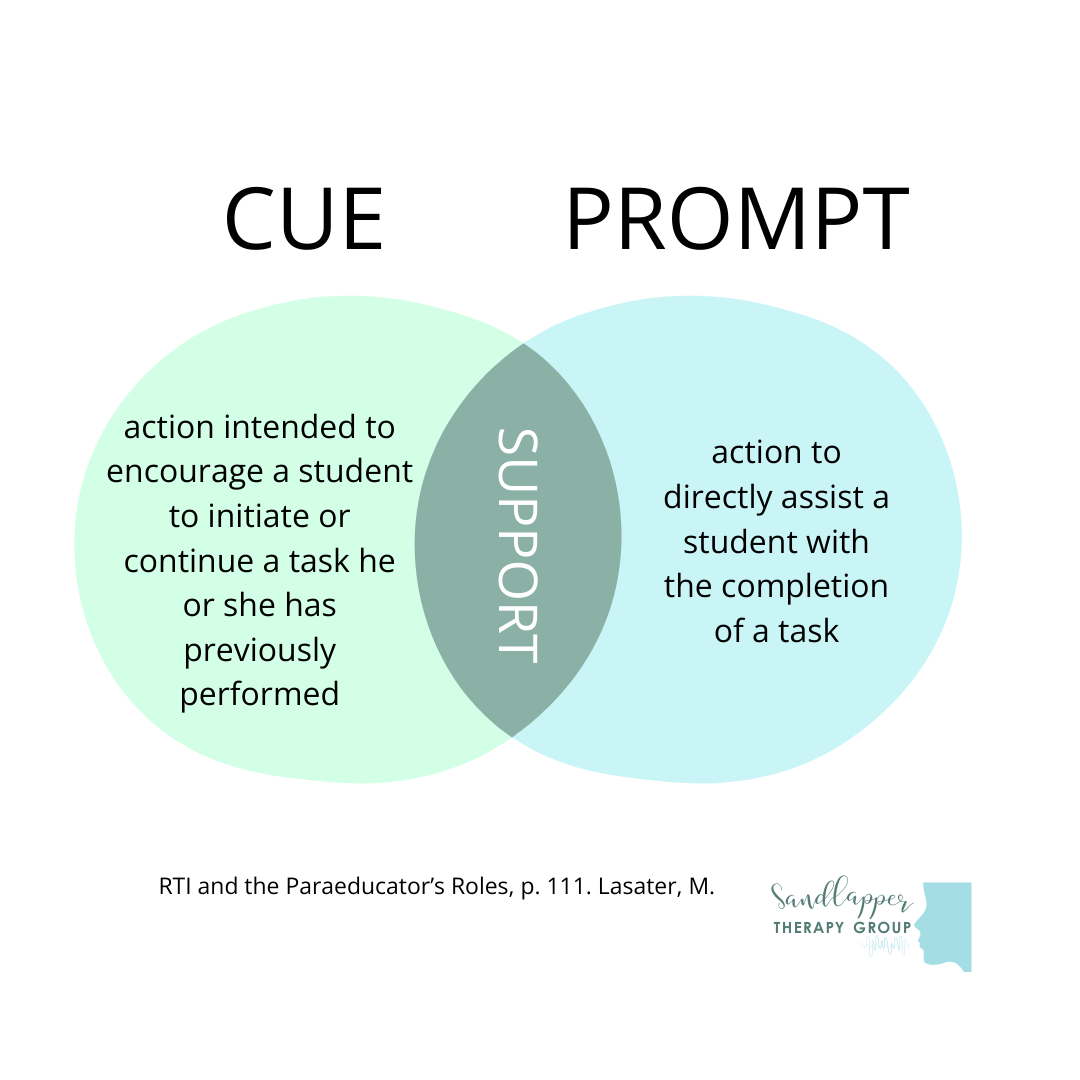
What Is a Cue?
A cue is an action intended to encourage a student to initiate or continue a task he or she has previously performed.
Cues:
Remind
Nudge
Signal
Encourage recall
Support independence
A cue does not directly give the answer. Instead, it helps the child access a skill they already know.
Examples of Cues in Speech Therapy:
Raising your eyebrows to signal “your turn”
Tapping your throat to remind a child to use voice
Saying, “Think about how we start that sound…”
Providing a visual schedule
Pointing to a communication board
Pausing expectantly
Cues are designed to reduce dependence and build internal processing.
What Is a Prompt?
A prompt is an action used to directly assist a student with the completion of a task.
Prompts:
Provide direct help
Supply part of the answer
Guide motor movements
Reduce error
Prompts are more supportive than cues and are often used when a child is first learning a new skill.
Examples of Prompts in Speech Therapy:
Giving the first sound: “/b/… ball”
Physically guiding tongue placement
Modeling the entire word
Hand-over-hand assistance
Saying the full answer for imitation
Prompts are appropriate during skill acquisition but should be gradually faded.
Why the Difference Matters
Speech-language pathologists carefully control the level of support provided during therapy. According to ASHA’s practice guidelines for intervention, therapy should promote:
Skill acquisition
Generalization
Independence
Functional communication
👉 https://www.asha.org/practice-portal/
Over-prompting can create prompt dependency, where a child waits for help instead of initiating independently.
Cues, when used appropriately, help bridge the gap toward independence.
The Support Continuum
In therapy, we often move through a hierarchy:
Full physical prompt
Partial physical prompt
Model prompt
Verbal prompt
Visual cue
Gestural cue
Independent response
This gradual fading process is supported by evidence-based behavioral and language intervention research (Wolery & Hemmeter, 2011).
Cueing and Prompting in Different Areas of Speech Therapy
Articulation Therapy
Prompt: “Say /s/ like this…” (model provided)
Cue: “Remember your snake sound.”
Language Therapy
Prompt: “Say ‘He is running.’”
Cue: “What is he doing?”
Social Communication
Prompt: “Say, ‘Can I play?’”
Cue: Eye contact and pause to signal turn-taking.
AAC (Augmentative and Alternative Communication)
Prompt: Hand-over-hand selecting a symbol.
Cue: Pointing to the device and waiting expectantly.
ASHA highlights the importance of systematic prompting and cue fading in AAC intervention to prevent dependency.
👉 https://www.asha.org/public/speech/disorders/aac/
Evidence-Based Practice and Prompt Fading
Research shows that systematic prompt fading improves long-term independence (Libby et al., 2008).
Key principles include:
Start with the least intrusive support possible.
Increase support only if needed.
Fade prompts as quickly as feasible.
Reinforce independent responses.
Prompt dependency is especially common in children with developmental delays or autism spectrum disorder when supports are not systematically reduced.
How Parents and Educators Can Use This Knowledge
✔ Use cues when a child already knows the skill.
✔ Use prompts when teaching a new skill.
✔ Pause before helping.
✔ Allow processing time (5–10 seconds).
✔ Fade support gradually.
✔ Celebrate independent attempts.
The ultimate goal is functional independence, not perfect performance.
Signs a Child May Be Prompt Dependent
Waits silently for adult help
Looks at adult before responding
Only performs correctly after full modeling
Struggles to generalize skills
In these cases, speech therapy may adjust the cueing hierarchy to promote independence.
The Role of Speech-Language Pathologists
SLPs are trained to:
Select the appropriate level of support
Monitor response accuracy
Systematically fade prompts
Encourage generalization
Collaborate with educators and families
ASHA emphasizes that intervention should be individualized and data-driven to ensure optimal outcomes.
👉 https://www.asha.org/public/
Final Thoughts
Cues and prompts both play important roles in speech therapy — but they serve different purposes.
Cues encourage independence.
Prompts provide direct assistance.
The goal is always to move toward independence while maintaining success and confidence.
If your child is receiving speech therapy and you have questions about cueing or prompting strategies, our team would be happy to explain how we support skill development in sessions.
Contact us today to schedule a consultation.
References
American Speech-Language-Hearing Association (ASHA). (2024). Practice Portal. Retrieved from https://www.asha.org/practice-portal/
American Speech-Language-Hearing Association (ASHA). (2024). Augmentative and Alternative Communication. Retrieved from https://www.asha.org/public/speech/disorders/aac/
Libby, M. E., Weiss, J. S., Bancroft, S., & Ahearn, W. H. (2008). A comparison of most-to-least and least-to-most prompting. Journal of Applied Behavior Analysis.
Wolery, M., & Hemmeter, M. L. (2011). Systematic instruction and prompt fading. Young Exceptional Children.
Lasater, M. (n.d.). RTI and the Paraeducator’s Roles.