
Steps to Build Verbal Imitation in Children: A Speech Therapy Guide for Parents
Verbal imitation is one of the most important building blocks of speech development. Before children use words independently, they learn to copy sounds, words, and phrases they hear from others.
If your child is not yet talking or is saying very few words, building verbal imitation is often the first goal in speech therapy.
According to the American Speech-Language-Hearing Association (ASHA), imitation skills are foundational for expressive language development and social communication.
👉 https://www.asha.org/public/speech/development/
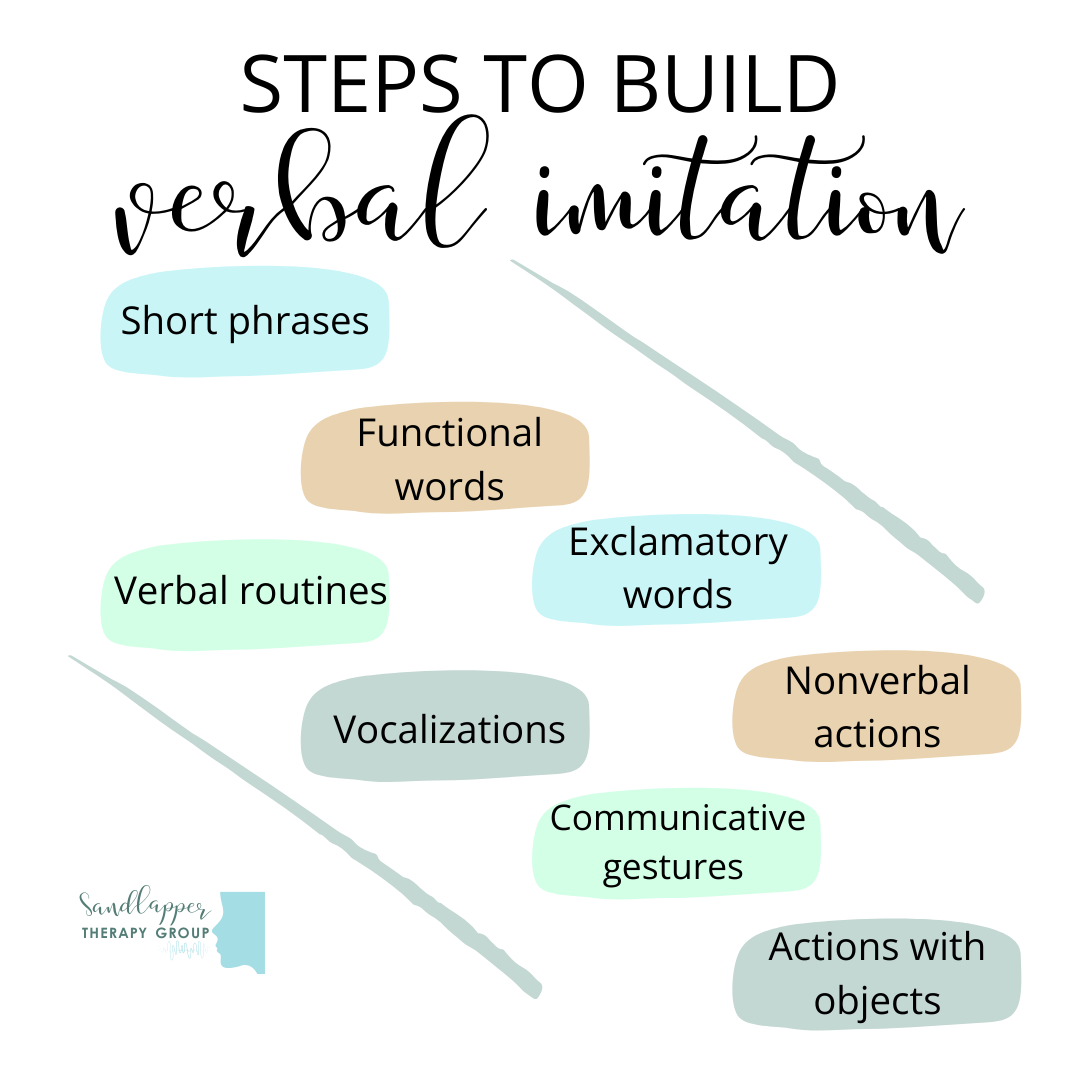
Below is a step-by-step guide to building verbal imitation, moving from simple, nonverbal skills to short phrases.
Why Verbal Imitation Matters
Children learn language through listening, watching, and copying. Imitation supports:
Vocabulary growth
Sound development
Sentence formation
Social engagement
Play skills
Research shows that children who develop strong imitation skills early tend to demonstrate faster expressive language growth (Ingersoll & Meyer, 2011).
The Hierarchy: Steps to Build Verbal Imitation
Speech-language pathologists often follow a developmental progression. The goal is to move from simple imitation to spontaneous speech.
1️⃣ Actions with Objects
Before speech, children imitate actions.
Examples:
Pushing a car
Feeding a baby doll
Rolling a ball
If a child can imitate play actions, they are building the foundation for verbal imitation.
Why this matters: Imitation of motor actions activates similar neural pathways used in speech imitation.
2️⃣ Nonverbal Actions
Next, children imitate body movements:
Clapping
Waving
Stomping
Blowing kisses
Nonverbal imitation shows that a child is paying attention and learning through modeling.
3️⃣ Communicative Gestures
Gestures bridge the gap between action and speech.
Examples:
Pointing
Nodding
Shaking head
Reaching
ASHA notes that gestures often predict later spoken vocabulary development.
👉 https://www.asha.org/public/speech/development/communication-milestones/
4️⃣ Vocalizations
Before real words, we target sound imitation:
“Ahh”
“Oooh”
“Mmm”
Animal sounds (“moo,” “woof”)
The goal is to encourage copying sounds without pressure.
Tip: Exaggerate facial expressions and keep it playful.
5️⃣ Exclamatory Words
These are fun, motivating early words:
“Uh oh!”
“Wow!”
“Yay!”
“Oh no!”
Exclamatory words are often easier than labeling words because they carry strong emotion and intonation.
6️⃣ Functional Words
Now we move to meaningful single words:
“More”
“Go”
“Up”
“Help”
“Open”
Functional words are powerful because they allow children to communicate needs.
7️⃣ Verbal Routines
Children learn language best in predictable routines.
Examples:
“Ready, set… go!”
“1, 2, 3!”
“Bye bye!”
“Night night”
Repetition in routines builds confidence and reduces cognitive load.
8️⃣ Short Phrases
Once single words are consistent, we expand:
“More juice”
“Go car”
“Mommy up”
“I want ___”
This is when expressive language begins to take off.
Evidence-Based Strategies to Support Verbal Imitation
Research-supported strategies include:
✔ Modeling Without Pressure
Say the word and pause. Avoid “Say it.” Instead, create opportunity.
✔ Environmental Arrangement
Place desired items slightly out of reach to encourage communication attempts.
✔ Expansion and Recasting
Child: “Car!”
Adult: “Yes! Red car!”
✔ Responsive Interaction
Follow the child’s lead in play.
Parent-implemented language interventions have strong research support for improving expressive language (Roberts & Kaiser, 2011).
When to Seek Help
Consider a speech evaluation if your child:
Does not imitate sounds by 18 months
Has limited eye contact or joint attention
Does not attempt to copy actions
Uses fewer than 10 words by 18 months
Is not combining words by age 2
Early intervention improves outcomes significantly.
The CDC’s developmental milestones resource can help parents track progress:
👉 https://www.cdc.gov/ncbddd/actearly/
Why Early Intervention Matters
Verbal imitation is strongly connected to:
Later vocabulary growth
Social communication skills
Academic readiness
Literacy development
Children who struggle with imitation may benefit from structured, play-based speech therapy focused on building foundational communication skills.
Final Thoughts
Speech development does not begin with full sentences — it begins with imitation.
From actions with objects to short phrases, each step builds on the one before it. If your child is not yet talking, start small. Celebrate sounds. Make it playful. Be consistent.
And if you’re concerned, a speech-language pathologist can guide you through this progression in a supportive, evidence-based way.
Contact our office today to schedule an evaluation and help your child build strong communication foundations.
References
American Speech-Language-Hearing Association (ASHA). (2024). Speech and Language Development. Retrieved from https://www.asha.org
American Speech-Language-Hearing Association (ASHA). (2024). Practice Portal: Spoken Language Disorders. Retrieved from https://www.asha.org/practice-portal/clinical-topics/spoken-language-disorders/
Centers for Disease Control and Prevention (CDC). (2023). Learn the Signs. Act Early. Retrieved from https://www.cdc.gov/ncbddd/actearly
Ingersoll, B., & Meyer, K. (2011). Examination of correlates of different imitative functions in young children with autism. Research in Autism Spectrum Disorders.
Roberts, M. Y., & Kaiser, A. P. (2011). The effectiveness of parent-implemented language interventions. American Journal of Speech-Language Pathology.