
Categories Target Activities in Speech Therapy: Building Vocabulary, Organization, and Critical Thinking
Understanding and organizing words into categories is a powerful language skill. When children learn how items relate to one another — what goes together, what doesn’t belong, and how things are similar or different — they strengthen vocabulary, reasoning, and academic readiness.
Category work is a common and highly effective speech therapy target because it supports both expressive and receptive language development.
According to the American Speech-Language-Hearing Association (ASHA), semantic organization (how words are grouped and stored in the brain) plays a key role in vocabulary growth, comprehension, and literacy development.
👉 https://www.asha.org/public/speech/development/language/
Below are evidence-based category activities frequently used in pediatric speech therapy.
Why Category Skills Matter
Category knowledge supports:
Vocabulary expansion
Word retrieval
Reading comprehension
Critical thinking
Narrative development
Academic performance
Research in semantic development shows that children who can organize vocabulary into categories demonstrate stronger lexical access and improved expressive language skills (Storkel, 2009).
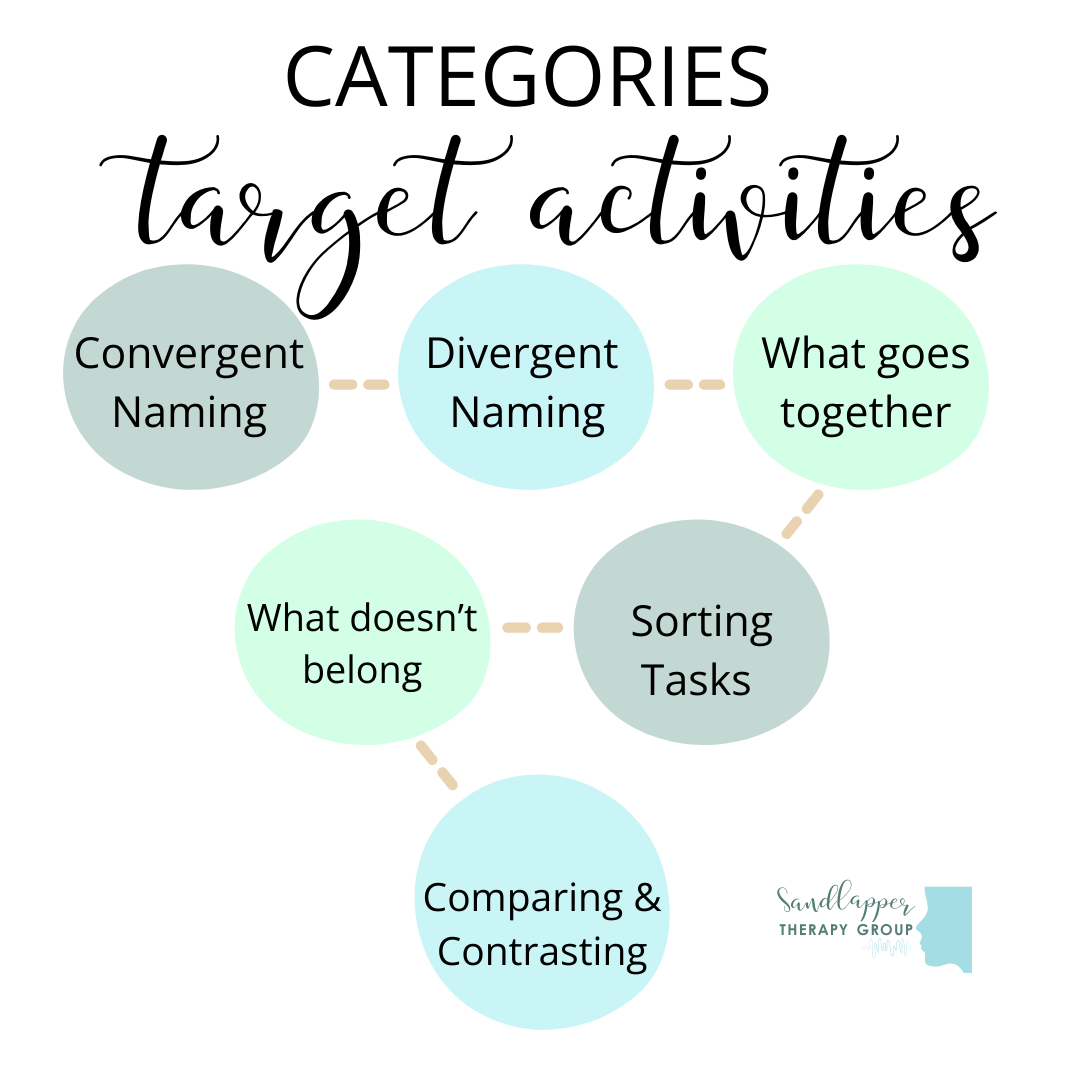
Core Categories Target Activities in Speech Therapy
1️⃣ Convergent Naming
What it is:
The child is given several items and must identify the category.
Example:
“Dog, cat, cow — what are they?”
Answer: “Animals.”
Why it matters:
Convergent naming strengthens abstract reasoning and vocabulary grouping.
2️⃣ Divergent Naming
What it is:
The child is given a category and must generate items within it.
Example:
“Name three fruits.”
“Tell me some things you wear.”
Why it matters:
Divergent naming supports word retrieval, expressive vocabulary, and fluency.
This skill is strongly connected to academic language demands in elementary school.
3️⃣ What Goes Together
What it is:
Children identify related items.
Example:
“Peanut butter and ___?” (Jelly)
“Socks and shoes go together.”
Why it matters:
Builds relational vocabulary and strengthens semantic associations.
4️⃣ What Doesn’t Belong
What it is:
Children identify the item that does not fit.
Example:
“Apple, banana, carrot, grape”
Answer: “Carrot” (not a fruit)
Why it matters:
Encourages critical thinking and classification skills.
5️⃣ Sorting Tasks
What it is:
Children physically sort items by category.
Examples:
Animals vs. vehicles
Foods vs. toys
Big vs. small
Hands-on sorting builds both language and cognitive flexibility.
6️⃣ Comparing & Contrasting
What it is:
Children describe similarities and differences between items.
Example:
“How are a dog and a cat alike?”
“How are they different?”
Why it matters:
Comparing and contrasting strengthens descriptive language, sentence structure, and executive functioning.
Developmental Progression of Category Skills
Category skills typically develop in this order:
Matching identical items
Sorting by simple features (color, shape)
Grouping by function
Identifying category labels
Generating multiple items within categories
Understanding abstract categories (e.g., “tools,” “transportation”)
According to the CDC developmental milestones, children begin simple categorization in toddlerhood, with more complex classification emerging in preschool and early elementary years.
👉 https://www.cdc.gov/ncbddd/actearly/
Signs a Child May Need Support With Categories
Consider a speech-language evaluation if your child:
Struggles to name items in common categories
Cannot explain why items go together
Has difficulty describing similarities/differences
Frequently says “I don’t know” during word retrieval tasks
Has reading comprehension challenges
Category deficits are often seen in children with:
Developmental Language Disorder (DLD)
ADHD
Autism Spectrum Disorder
Word retrieval difficulties
ASHA’s Practice Portal discusses spoken language disorders and semantic development in more depth:
👉 https://www.asha.org/practice-portal/clinical-topics/spoken-language-disorders/
Evidence-Based Strategies for Building Category Skills at Home
✔ Use Everyday Routines
At the grocery store:
“Let’s find fruits.”
“What category is milk in?”
✔ Read Themed Books
Group books by animals, transportation, or emotions.
✔ Play Sorting Games
Laundry sorting
Toy clean-up categories
Pantry organization
✔ Use “Why?” Questions
“Why does this not belong?”
Research supports explicit vocabulary instruction and semantic mapping for improving word learning and retention (Stahl & Nagy, 2006).
How Category Work Supports Academic Success
Strong semantic networks improve:
Reading comprehension
Writing organization
Test performance
Verbal reasoning
Classroom participation
Category knowledge is directly linked to literacy outcomes, especially in early elementary grades.
Final Thoughts
Category activities are more than just sorting games — they build the foundation for vocabulary organization, reasoning, and academic language.
If your child struggles with word retrieval, comprehension, or expressive language, targeted category intervention can significantly improve communication skills.
Contact our office today to schedule a comprehensive speech and language evaluation and help your child strengthen their language foundations.
References
American Speech-Language-Hearing Association (ASHA). (2024). Language Development. Retrieved from https://www.asha.org
American Speech-Language-Hearing Association (ASHA). (2024). Spoken Language Disorders Practice Portal. Retrieved from https://www.asha.org/practice-portal/clinical-topics/spoken-language-disorders/
Centers for Disease Control and Prevention (CDC). (2023). Learn the Signs. Act Early. Retrieved from https://www.cdc.gov/ncbddd/actearly
Stahl, S. A., & Nagy, W. E. (2006). Teaching Word Meanings. Lawrence Erlbaum Associates.
Storkel, H. L. (2009). Developmental differences in the effects of phonological, lexical, and semantic variables on word learning. Journal of Child Language.