
Pronoun Development Milestones: When Do Children Learn “I,” “Me,” “Mine,” and More?
Pronouns are small words that carry big meaning. Words like I, me, you, he, she, mine, yours, theirs, myself help children talk about people, ownership, and relationships.
Understanding pronoun development averages helps parents know what’s typical — and when it might be time to seek guidance from a speech-language pathologist.
According to research in early language development and guidance from the American Speech-Language-Hearing Association (ASHA), pronouns emerge gradually between ages 1 and 4, becoming more refined over time.
Learn more about language development from ASHA here:
👉 https://www.asha.org/public/speech/development/language/
Why Pronouns Matter in Language Development
Pronouns are part of grammar (syntax and morphology). They require:
Perspective-taking
Understanding relationships
Correct word order
Proper sentence structure
Because pronouns shift depending on who is speaking (“I” vs. “you”), they are more complex than nouns. It’s common for toddlers to reverse pronouns early on (e.g., saying “You want cookie” when they mean “I want cookie”).
This is typically part of normal development.
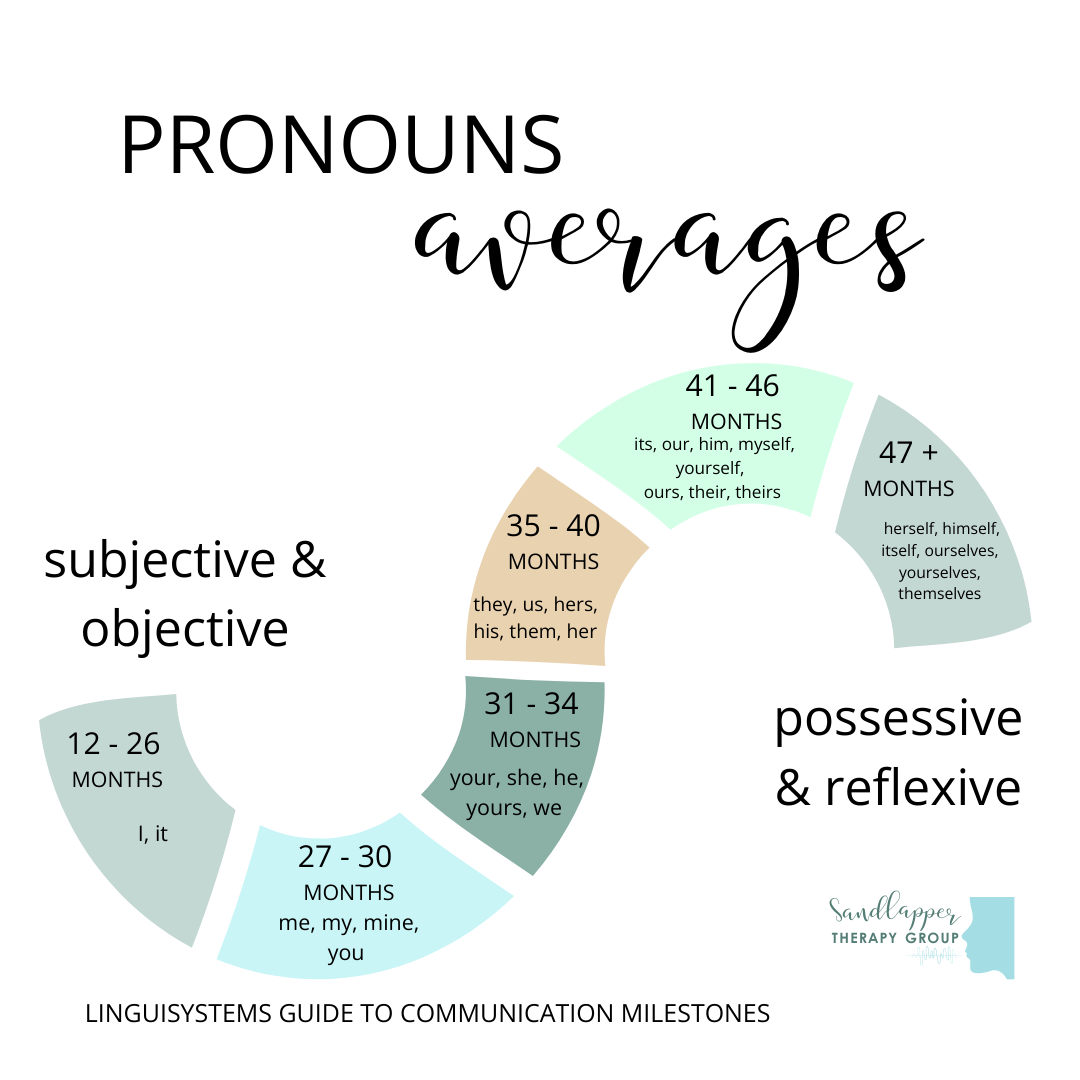
Pronoun Development Averages by Age
Below is a breakdown of typical pronoun acquisition based on developmental norms and research in early language milestones.
12–26 Months
Emerging subjective pronouns
I
it
At this stage, toddlers begin referring to themselves and objects. “I” may be inconsistent at first.
27–30 Months
Objective & possessive pronouns begin emerging
me
my
mine
you
Children start expressing ownership (“my toy”) and addressing others directly.
31–34 Months
Expanding subject pronouns
your
she
he
yours
we
Perspective-taking improves, and children begin using third-person pronouns more accurately.
35–40 Months
Objective pronouns and gender forms
they
us
hers
his
them
her
Children begin distinguishing between subject and object pronouns and expand plural forms.
41–46 Months
Possessive and reflexive forms
its
our
him
myself
yourself
ours
their
theirs
Grammar becomes more consistent, though occasional errors are still common.
47+ Months (Around 4 Years and Beyond)
Advanced reflexive pronouns
herself
himself
itself
ourselves
yourselves
themselves
By preschool age, most children use pronouns consistently and grammatically within sentences.
Common Pronoun Errors (And When They’re Normal)
It is typical for young children to:
Reverse pronouns (“You do it” instead of “I do it”)
Overgeneralize (“Him go” instead of “He goes”)
Confuse possessives (“Me toy” instead of “My toy”)
ASHA notes that grammatical development continues through early elementary years. Occasional errors under age 4 are usually part of normal language growth.
However, persistent pronoun confusion after age 4–5 may signal a language delay or grammatical disorder.
Learn about spoken language disorders here:
👉 https://www.asha.org/practice-portal/clinical-topics/spoken-language-disorders/
Why Pronoun Development Can Be Delayed
Pronoun delays may be associated with:
Developmental language disorder (DLD)
Autism spectrum disorder (ASD)
Hearing loss
Limited language exposure
Cognitive processing differences
The CDC’s developmental milestone resources emphasize monitoring grammar growth alongside vocabulary development.
👉 https://www.cdc.gov/ncbddd/actearly/
How Parents Can Support Pronoun Development
You can help strengthen pronoun use naturally at home:
1. Model Correct Pronouns
Child: “Me want juice.”
Parent: “Oh, I want juice!”
2. Use Play-Based Practice
Pretend play (“She is cooking.”)
Role play (“You be the doctor, I’ll be the patient.”)
3. Emphasize Ownership
“Is this your shoe?”
“That’s my cup.”
4. Expand Sentences
If your child says, “Mine!”
Respond: “That is mine. It belongs to me.”
Research shows that responsive language modeling supports grammatical growth (Roberts & Kaiser, 2011).
When to Seek a Speech Evaluation
Consider consulting a speech-language pathologist if your child:
Rarely uses pronouns by age 3
Frequently mixes up pronouns after age 4
Uses mostly names instead of pronouns
Shows delays in other grammar skills
Early intervention significantly improves outcomes for children with language delays.
Final Thoughts
Pronoun development is a gradual process that reflects growing social awareness and grammatical skill. From “I” and “me” in toddlerhood to “themselves” and “ourselves” in preschool, these small words signal big cognitive growth.
If you have concerns about your child’s grammar or sentence development, early support can make a meaningful difference.
Contact our office today to schedule a speech and language evaluation and ensure your child’s communication skills are on track.
References
American Speech-Language-Hearing Association (ASHA). (2024). Language Development. Retrieved from https://www.asha.org
American Speech-Language-Hearing Association (ASHA). (2024). Spoken Language Disorders Practice Portal. Retrieved from https://www.asha.org/practice-portal/clinical-topics/spoken-language-disorders/
Centers for Disease Control and Prevention (CDC). (2023). Learn the Signs. Act Early. Retrieved from https://www.cdc.gov/ncbddd/actearly
Owens, R. E. (2020). Language Development: An Introduction. Pearson.
Roberts, M. Y., & Kaiser, A. P. (2011). The effectiveness of parent-implemented language interventions. American Journal of Speech-Language Pathology.