
Spoken Language Mean Length Milestones: Understanding MLU in Early Language Development
When parents think about language development, they often focus on how many words their child says. But speech-language pathologists look at something just as important:
👉 How long and complex your child’s sentences are.
One of the most reliable measures of early expressive language development is Mean Length of Utterance (MLU) — a key concept based on Brown’s Stages of Language Development.
Understanding MLU can help determine whether your child’s spoken language skills are progressing as expected — and whether early intervention may be beneficial.
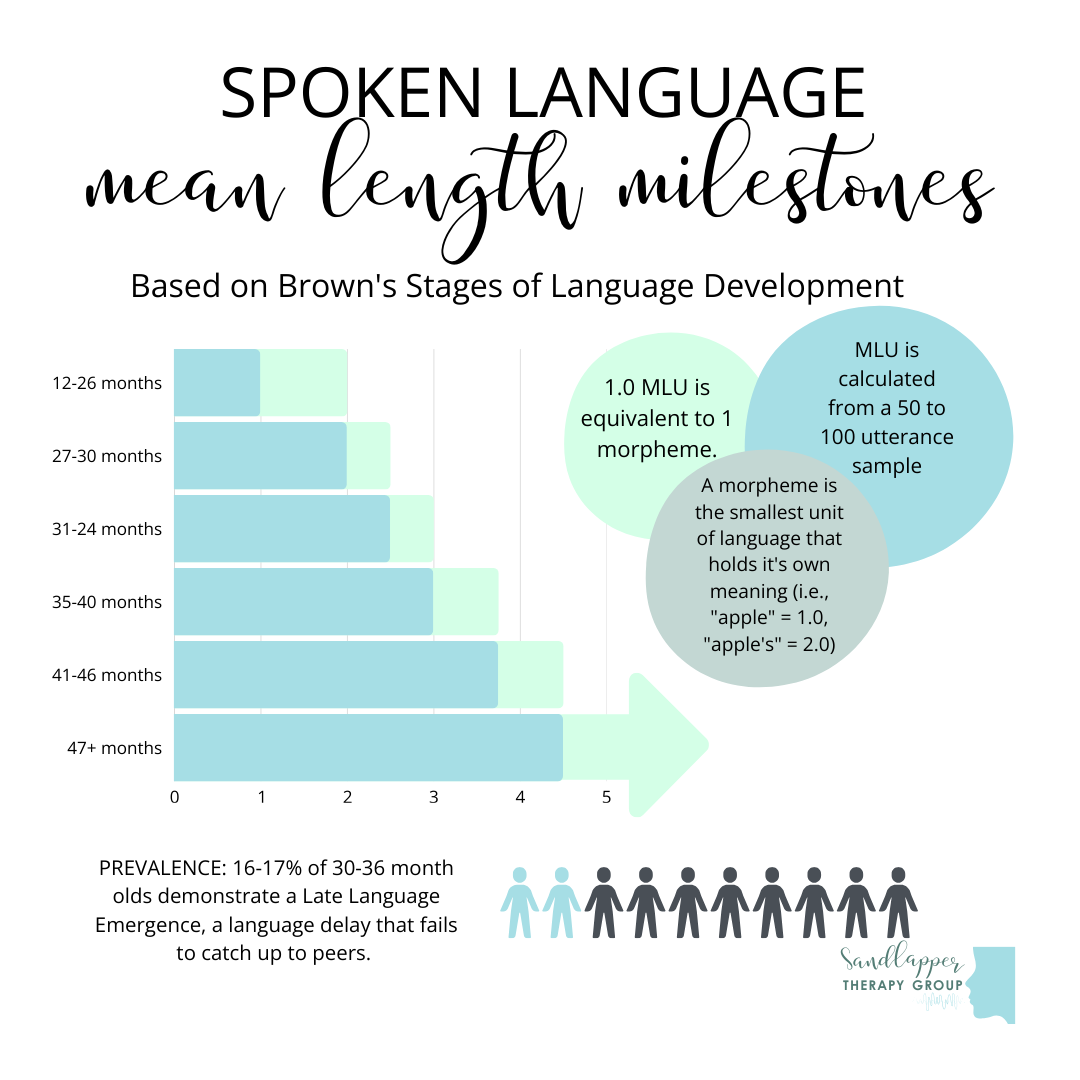
What Is Mean Length of Utterance (MLU)?
Mean Length of Utterance (MLU) measures the average number of morphemes a child uses per sentence.
A morpheme is the smallest unit of language that carries meaning.
For example:
“Dog” = 1 morpheme
“Dogs” = 2 morphemes (dog + plural -s)
“Jumped” = 2 morphemes (jump + -ed)
“He is running” = 4 morphemes (he + is + run + -ing)
An MLU of 1.0 equals one morpheme per utterance.
MLU is calculated from a 50–100 utterance language sample, which gives a more accurate picture of how a child communicates in real-life conversation.
The American Speech-Language-Hearing Association (ASHA) identifies language sampling as an essential part of a comprehensive language evaluation.
Learn more here:
👉 https://www.asha.org/practice-portal/clinical-topics/spoken-language-disorders/
Brown’s Stages of Language Development
Roger Brown (1973) identified predictable stages of grammatical development in young children. These stages are still widely used in pediatric speech-language pathology today.
Here’s a simplified overview of typical MLU milestones:
Stage I (12–26 months)
MLU: 1.0–2.0
Single words
Two-word combinations
Early vocabulary
Examples:
“Mommy go”
“More milk”
Stage II (27–30 months)
MLU: 2.0–2.5
Emergence of grammatical markers
-ing verbs (“running”)
Plurals (-s)
Simple prepositions (“in,” “on”)
Stage III (31–34 months)
MLU: 2.5–3.0
Regular past tense (-ed)
Possessives (“mommy’s”)
More structured sentences
Stage IV (35–40 months)
MLU: 3.0–3.75
Articles (“a,” “the”)
Irregular past tense
Expanded sentence complexity
Stage V (41–46 months)
MLU: 3.75–4.5
Third person singular (-s)
Auxiliary verbs (“is,” “are”)
More grammatically complete sentences
47+ Months
MLU: 4.5+
Complex grammar
Embedded clauses
Multi-clause sentences
By preschool and early elementary years, children should be producing increasingly complex and grammatically accurate sentences.
Why MLU Matters for School Readiness
Sentence length and grammatical development are strong predictors of:
Reading readiness
Writing skills
Comprehension
Academic performance
Research shows that children with lower-than-expected MLU scores are at greater risk for expressive language disorders and later literacy difficulties.
The National Institute on Deafness and Other Communication Disorders (NIDCD) emphasizes the importance of early language development for school success:
👉 https://www.nidcd.nih.gov/health/speech-and-language
Late Language Emergence (LLE)
Approximately 16–17% of 30–36 month olds demonstrate Late Language Emergence (LLE) — meaning expressive language skills lag behind peers.
Some children catch up naturally. Others require structured intervention.
ASHA defines Late Language Emergence and outlines guidelines for monitoring and treatment:
👉 https://www.asha.org/practice-portal/clinical-topics/late-language-emergence/
Early evaluation helps determine which children may benefit from therapy.
Evidence-Based Language Intervention
Speech therapy targeting MLU and grammar growth may include:
Expansion and recasting (adult models longer sentences)
Focused stimulation of grammatical markers
Enhanced Milieu Teaching
Play-based language modeling
Parent coaching for daily language support
A meta-analysis by Roberts & Kaiser (2011) demonstrated that parent-implemented language interventions significantly improve expressive language outcomes.
Early, consistent, and naturalistic intervention approaches are strongly supported in the research literature.
Signs Your Child May Need a Language Evaluation
Consider a speech-language evaluation if your child:
Uses mostly single words after age 2
Is not combining words by 24–30 months
Uses shorter sentences than peers
Has difficulty using grammatical markers
Is not increasing sentence complexity over time
A comprehensive evaluation includes both standardized testing and conversational language sampling to accurately measure MLU.
Final Thoughts
Mean Length of Utterance (MLU) provides a powerful snapshot of how your child’s grammar and sentence structure are developing.
Typical progression:
Toddlers: 1–2 morphemes
Young preschoolers: 2–3 morphemes
Older preschoolers: 3–4+ morphemes
By 4–5 years: increasingly complex sentences
If your child’s spoken language seems significantly shorter or less complex than peers, early support can make a meaningful difference.
If you have concerns about your child’s expressive language development, contact our office today to schedule a comprehensive language evaluation.
References
American Speech-Language-Hearing Association (ASHA). (2024). Spoken Language Disorders Practice Portal. Retrieved from https://www.asha.org
American Speech-Language-Hearing Association (ASHA). (2024). Late Language Emergence. Retrieved from https://www.asha.org/practice-portal/clinical-topics/late-language-emergence/
Brown, R. (1973). A First Language: The Early Stages. Harvard University Press.
National Institute on Deafness and Other Communication Disorders (NIDCD). (2023). Speech and Language Development. Retrieved from https://www.nidcd.nih.gov
Roberts, M. Y., & Kaiser, A. P. (2011). The effectiveness of parent-implemented language interventions. American Journal of Speech-Language Pathology.