
Speech Intelligibility to Unfamiliar Listeners
One of the most common concerns we hear from parents is:
“I can understand my child, but other people can’t. Is that normal?”
Speech intelligibility — especially to unfamiliar listeners — is a key indicator of healthy speech development. While parents and caregivers naturally understand their child better, there are expected milestones for how clearly children should speak as they grow.
If your child is frequently misunderstood by teachers, peers, or extended family members, it may be time to take a closer look.
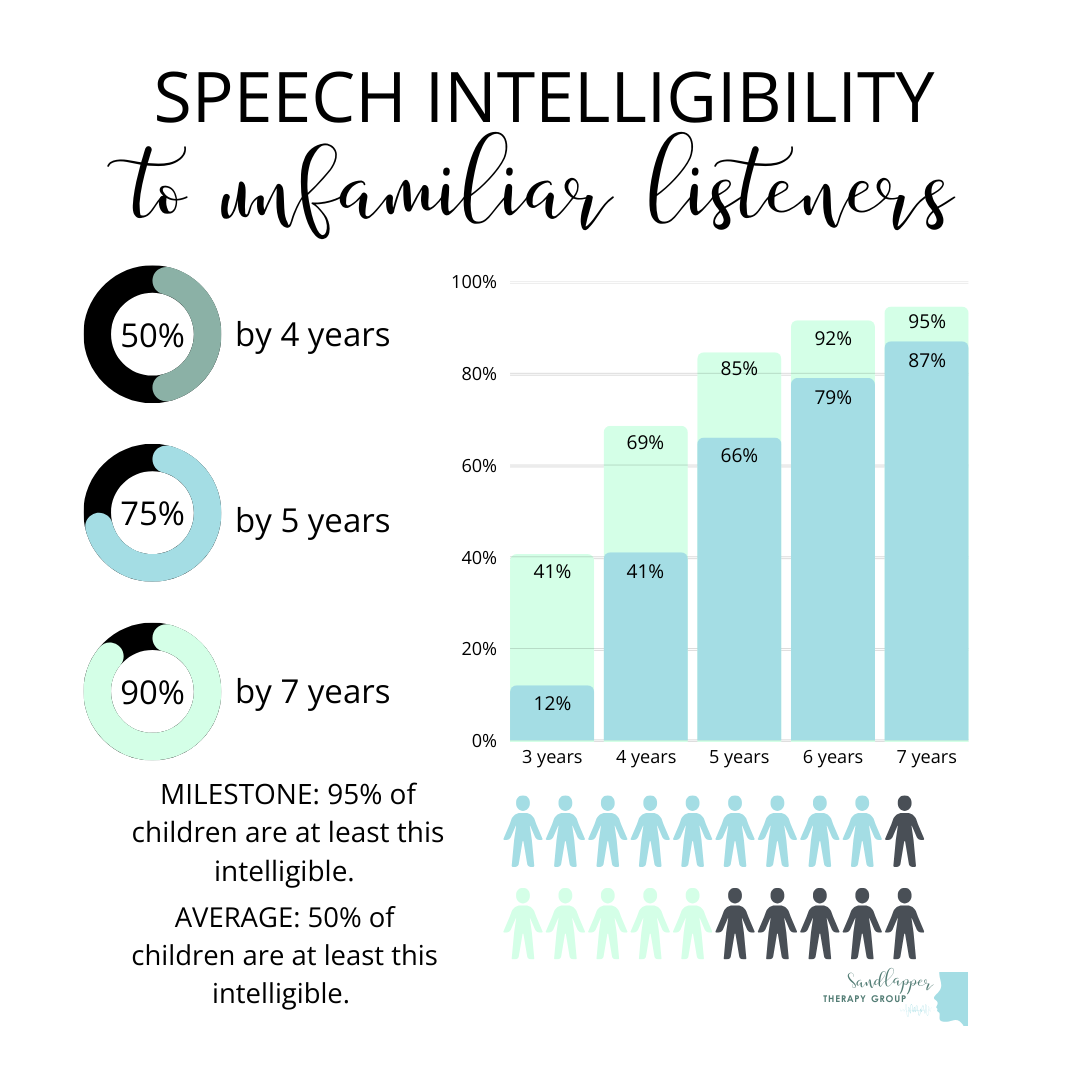
What Is Speech Intelligibility?
Speech intelligibility refers to how much of a child’s spoken message can be understood by a listener.
When we talk about intelligibility to unfamiliar listeners, we mean people who don’t regularly interact with the child — such as teachers, classmates, coaches, or community members.
According to developmental research commonly referenced in pediatric speech-language pathology, general benchmarks include:
By 3–4 years: ~50% intelligible
By 4–5 years: ~75% intelligible
By 6–7 years: ~90% or more intelligible
By age 7, approximately 95% of children are at least 90% intelligible, meaning they can be understood almost all of the time by someone who does not know them well.
These benchmarks are supported by classic developmental research (Coplan & Gleason, 1988) and more recent longitudinal studies examining speech intelligibility growth patterns (Hustad et al., 2021).
Average vs. Milestone: What’s the Difference?
Understanding the difference between average and milestone is important.
Average means about 50% of children perform at that level.
Milestone means about 95% of children can perform that skill.
If a child is significantly below milestone expectations, it may indicate a speech sound disorder that warrants evaluation.
The American Speech-Language-Hearing Association (ASHA) emphasizes that speech sound disorders can impact academic success, peer relationships, and overall participation if not addressed early.
Learn more from ASHA here:
👉 https://www.asha.org/public/speech/disorders/speech-sound-disorders/
Why Intelligibility to Unfamiliar Listeners Matters
Parents often adapt to their child’s speech patterns and can “fill in the gaps.” However, unfamiliar listeners do not have that advantage.
Reduced intelligibility can lead to:
Peer frustration or teasing
Difficulty participating in classroom discussions
Avoidance of speaking situations
Lower self-confidence
Increased communication breakdowns
Research has shown that early speech sound disorders are associated with later literacy and academic challenges (Lewis et al., 2000; Peterson et al., 2009). Clear speech supports phonological awareness — a foundational skill for reading.
The CDC’s “Learn the Signs. Act Early.” initiative encourages parents to seek evaluation when developmental concerns arise rather than adopting a “wait and see” approach.
👉 https://www.cdc.gov/ncbddd/actearly
What Causes Reduced Intelligibility?
Several factors may impact how clearly a child speaks:
1. Articulation Disorders
Difficulty producing individual sounds correctly (e.g., /r/, /s/, /l/, /th/).
2. Phonological Disorders
Patterns of sound errors, such as:
“Tat” for “cat”
“Pane” for “plane”
3. Childhood Apraxia of Speech
A motor planning disorder that affects coordination of speech movements.
4. Hearing Differences
Hearing plays a critical role in speech development.
5. Fluency or Voice Concerns
While different from articulation disorders, stuttering or voice quality differences can also affect overall intelligibility.
ASHA outlines these diagnostic categories within its Practice Portal for Speech Sound Disorders:
👉 https://www.asha.org/practice-portal/clinical-topics/articulation-and-phonology/
Evidence-Based Therapy for Improving Intelligibility
Speech-language pathologists use research-supported interventions tailored to the underlying cause of reduced intelligibility.
Evidence-based approaches include:
Motor-based articulation therapy guided by motor learning principles (Maas et al., 2008)
Phonological contrast therapy for sound pattern errors (Gierut, 2001)
Cycles approach for children with multiple sound errors (Hodson, 2010)
Parent coaching and structured home practice to support generalization
A growing body of research supports early, systematic intervention to improve speech clarity and prevent long-term academic impact (Hustad et al., 2021).
When Should You Seek a Speech Evaluation?
Consider scheduling a comprehensive speech-language evaluation if:
Your child is difficult for unfamiliar listeners to understand
Teachers report frequent misunderstandings
Your child becomes frustrated when communicating
Intelligibility is below 75% by age 4–5
Speech is not mostly clear by age 6–7
Early intervention leads to stronger and faster progress compared to waiting.
What Happens During a Speech Evaluation?
A comprehensive evaluation may include:
Standardized articulation and phonology assessments
Speech intelligibility rating scales
Oral motor examination
Hearing screening referral if appropriate
Parent and teacher questionnaires
Individualized treatment recommendations
Speech therapy sessions are engaging, play-based (for young children), and structured to build both skill and confidence.
Final Thoughts
While some speech errors are typical in early childhood, children should become progressively easier to understand each year.
General guidelines:
50% intelligible by age 3–4
75% intelligible by age 4–5
90%+ intelligible by age 6–7
If your child’s speech is frequently misunderstood by unfamiliar listeners, early support can make a meaningful difference.
If you’re looking for pediatric speech therapy services in your area, our team is here to help. Contact us today to schedule a comprehensive speech evaluation and ensure your child’s voice is heard clearly and confidently.
References
American Speech-Language-Hearing Association (ASHA). (2024). Speech Sound Disorders Practice Portal. Retrieved from https://www.asha.org
Centers for Disease Control and Prevention (CDC). (2023). Learn the Signs. Act Early. Retrieved from https://www.cdc.gov/ncbddd/actearly
Coplan, J., & Gleason, J. R. (1988). Unclear speech: Recognition and significance of unintelligible speech in preschool children. Pediatrics.
Gierut, J. A. (2001). Complexity in phonological treatment. Journal of Speech, Language, and Hearing Research.
Hodson, B. W. (2010). Evaluating and Enhancing Children’s Phonological Systems.
Hustad, K. C., et al. (2021). Longitudinal growth in speech intelligibility in children. Journal of Speech, Language, and Hearing Research.
Lewis, B. A., et al. (2000). Speech sound disorders and literacy outcomes. Journal of Speech, Language, and Hearing Research.
Maas, E., et al. (2008). Principles of motor learning in treatment of motor speech disorders. American Journal of Speech-Language Pathology.
Peterson, R. L., et al. (2009). Speech sound disorder and reading outcomes. Journal of Child Psychology and Psychiatry.
National Institute on Deafness and Other Communication Disorders (NIDCD). (2023). Speech and Language Development. Retrieved from https://www.nidcd.nih.gov