
The Difference Between Speech and Language: What Parents Need to Know
If you’ve ever wondered whether your child has a speech delay or a language delay, you’re not alone. These terms are often used interchangeably—but they mean very different things.
Understanding the difference between speech and language is the first step toward getting the right support for your child. As speech-language pathologists (SLPs), we help families navigate both.
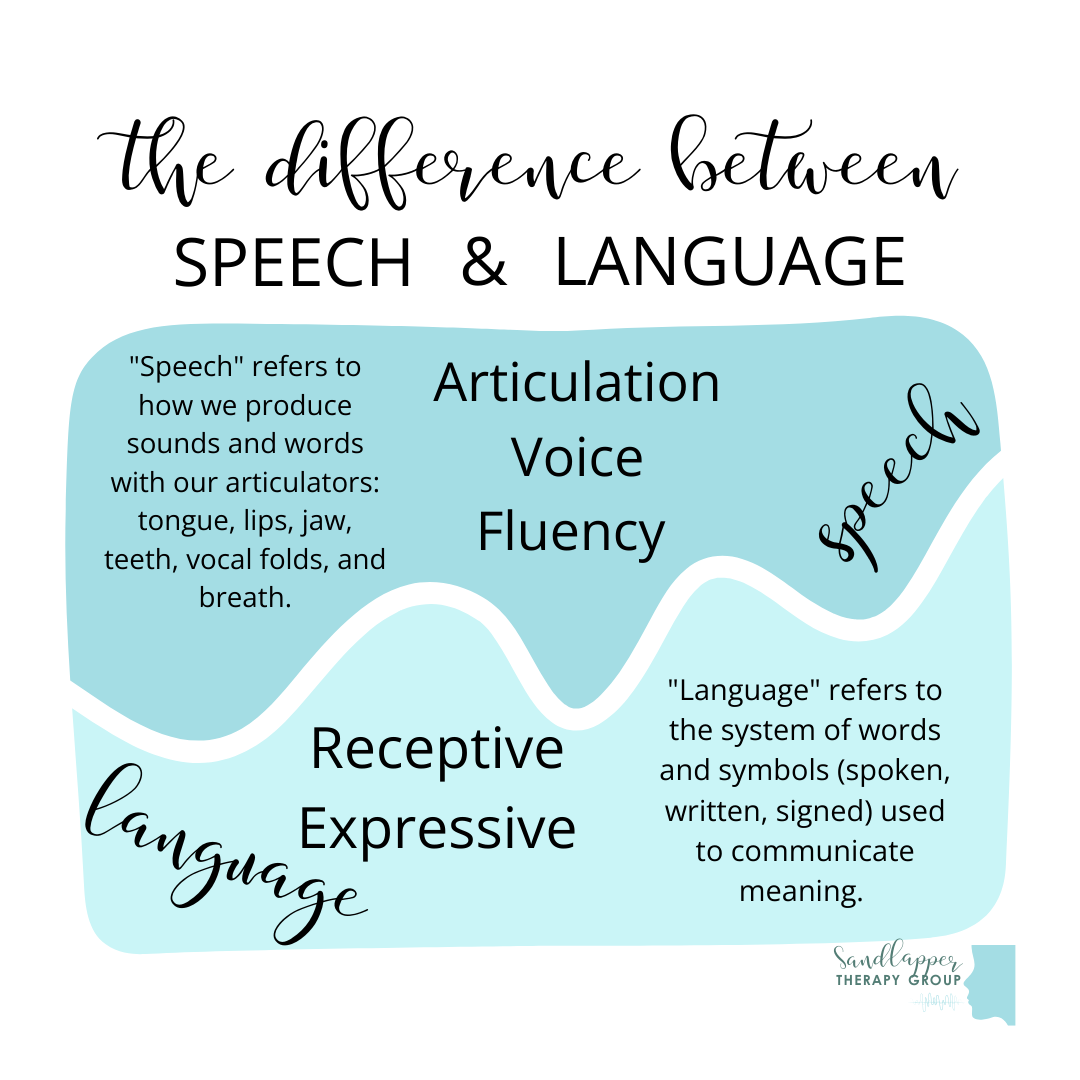
What Is Speech?
Speech refers to how we produce sounds and words using our articulators:
Tongue
Lips
Jaw
Teeth
Vocal folds
Breath
Speech is the physical act of talking.
According to the American Speech-Language-Hearing Association (ASHA), speech includes several key components:
1. Articulation
The ability to produce speech sounds correctly (for example, saying “rabbit” instead of “wabbit”).
2. Voice
The quality, pitch, and loudness of the sound produced by the vocal folds.
3. Fluency
The flow and rhythm of speech (for example, stuttering is a fluency disorder).
A child may have strong understanding and vocabulary (language skills) but still struggle to pronounce words clearly. That would be considered a speech disorder.
What Is Language?
Language refers to the system of words and symbols—spoken, written, or signed—that we use to communicate meaning.
Language includes:
Receptive Language
The ability to understand words, directions, and questions.
Expressive Language
The ability to use words, sentences, gestures, or signs to communicate thoughts and needs.
ASHA defines language as a socially shared code or system for representing concepts through symbols and rule-governed combinations of those symbols (ASHA, 2024).
A child with a language delay may:
Have difficulty following directions
Struggle to answer questions
Use short or grammatically incorrect sentences
Have limited vocabulary
Have trouble telling stories
Importantly, a child can pronounce words clearly (speech is intact) but have difficulty forming sentences or understanding language. That would be a language disorder.
Speech vs. Language: Why the Difference Matters
Understanding the distinction helps determine:
What type of evaluation is needed
Which therapy goals to target
How progress is measured
Whether support is needed at school or privately
For example:
If the difficulty is with…It may be…Sound productionArticulation disorder (speech)StutteringFluency disorder (speech)Hoarse or strained voiceVoice disorder (speech)Understanding directionsReceptive language disorderForming sentencesExpressive language disorder
Many children experience both speech and language challenges, and treatment plans are individualized based on evidence-based assessment.
What Does the Research Say?
Early identification and intervention are critical.
Research published in Pediatrics indicates that early language delays are associated with later academic and literacy challenges if left untreated (McLaughlin, 2011).
The National Institute on Deafness and Other Communication Disorders (NIDCD) emphasizes that speech and language disorders affect approximately 1 in 12 U.S. children ages 3–17 (NIDCD, 2023).
Evidence-based speech-language therapy has been shown to significantly improve communication outcomes when intervention is initiated early (Law et al., 2004; updated systematic reviews continue to support early intervention models).
You can learn more from trusted resources:
American Speech-Language-Hearing Association (ASHA): https://www.asha.org
Centers for Disease Control and Prevention (CDC) Developmental Milestones: https://www.cdc.gov/ncbddd/actearly
National Institute on Deafness and Other Communication Disorders (NIDCD): https://www.nidcd.nih.gov
These sites provide up-to-date, research-backed information and are highly trusted in the field of communication sciences.
When Should You Be Concerned?
You may want to seek a speech-language evaluation if your child:
Is difficult to understand compared to peers
Is not meeting developmental communication milestones
Becomes frustrated when trying to communicate
Stutters or repeats sounds frequently
Has a hoarse or unusual voice quality
Has trouble following age-appropriate directions
The CDC’s developmental milestone checklist can help parents track expected communication skills by age.
How Speech Therapy Helps
A licensed speech-language pathologist provides:
Comprehensive speech and language evaluations
Individualized treatment plans
Evidence-based therapy approaches
Parent coaching and home strategies
Collaboration with teachers and pediatricians
Therapy may target articulation practice, vocabulary development, grammar, social communication skills, fluency shaping techniques, or voice therapy depending on the child’s needs.
Final Thoughts
Speech and language are closely connected—but they are not the same.
Speech is how we say sounds and words (articulation, voice, fluency).
Language is how we understand and use words to communicate meaning (receptive and expressive skills).
If you have concerns about your child’s communication, early support can make a lasting difference.
If you’re located in our community and would like to schedule a comprehensive speech and language evaluation, contact our office today. We’re here to help your child find their voice—and their words.
References
American Speech-Language-Hearing Association (ASHA). (2024). Speech Sound Disorders—Articulation and Phonology. Retrieved from https://www.asha.org
American Speech-Language-Hearing Association (ASHA). (2024). Language in Brief. Retrieved from https://www.asha.org/public/speech/development/language/
Centers for Disease Control and Prevention (CDC). (2023). Developmental Milestones. Retrieved from https://www.cdc.gov/ncbddd/actearly
Law, J., Garrett, Z., & Nye, C. (2004). The efficacy of treatment for children with developmental speech and language delay/disorder: A meta-analysis. Journal of Speech, Language, and Hearing Research.
McLaughlin, M. R. (2011). Speech and language delay in children. Pediatrics, 127(5), e1200–e1208.
National Institute on Deafness and Other Communication Disorders (NIDCD). (2023). Quick Statistics About Voice, Speech, Language. Retrieved from https://www.nidcd.nih.gov/health/statistics/quick-statistics-speech-language