
Sentence Structure Development Norms: What to Expect Between 24–36 Months
One of the most exciting parts of early language development is hearing your toddler move from single words to real sentences. Between 24 and 36 months, children make rapid progress in sentence structure, grammar, and conversational skills.
If you’re wondering whether your child’s sentences are developing as expected, this guide will walk you through typical milestones — and when to consider a speech-language evaluation.
Why Sentence Structure Matters
Sentence structure (also called syntax) refers to how words are combined to form meaningful sentences.
Strong sentence development supports:
Clear communication
Reading readiness
Storytelling skills
Academic success
Social interaction
The American Speech-Language-Hearing Association (ASHA) explains that expressive language development during the toddler and preschool years lays the foundation for later literacy and classroom performance.
Learn more here:
👉 https://www.asha.org/public/speech/development/language/
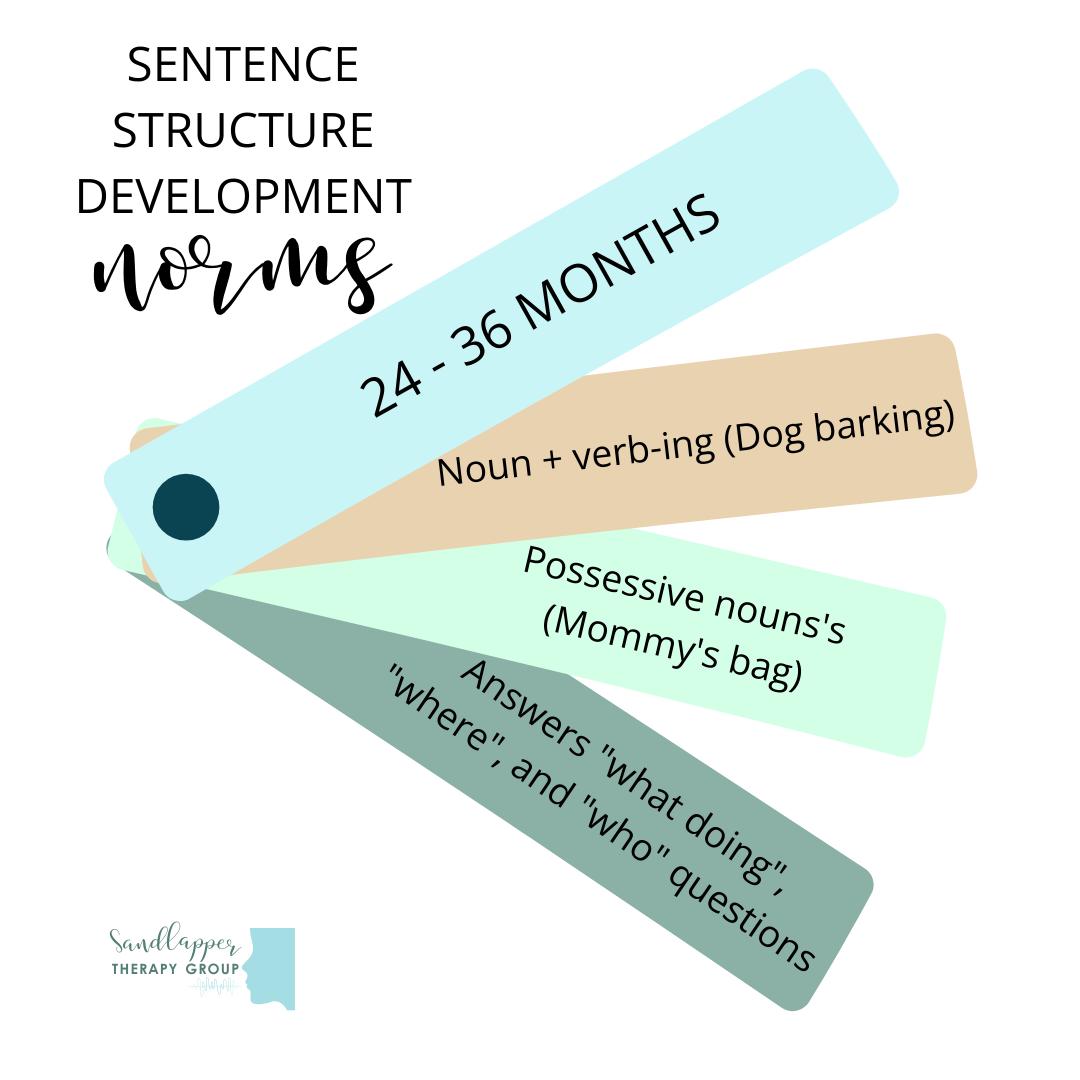
Sentence Structure Milestones: 24–36 Months
Between ages 2 and 3, children begin expanding their sentences in predictable ways.
1. Noun + Verb-ing Combinations
Children start combining a noun with an action word ending in -ing.
Examples:
“Dog barking”
“Baby sleeping”
“Daddy cooking”
This stage reflects increasing grammatical awareness and aligns with Brown’s Stage II of language development, where early grammatical markers emerge.
2. Possessive Nouns
Children begin using possessive forms to show ownership.
Examples:
“Mommy’s bag”
“Daddy’s car”
“Baby’s toy”
The possessive -’s is an important grammatical marker typically emerging during this period.
3. Answering Basic Questions
By 24–36 months, children begin answering simple:
“What doing?” questions
“Where?” questions
“Who?” questions
Examples:
“Dog running.”
“In car.”
“Mommy.”
Their responses may still be short, but they demonstrate understanding of sentence structure and conversational exchange.
How Sentence Length Grows
During this stage, children typically move from:
Two-word combinations (e.g., “more juice”)
toThree- to four-word sentences (e.g., “I want juice”)
Speech-language pathologists often measure growth using Mean Length of Utterance (MLU) — a research-supported method of analyzing grammatical development (Brown, 1973).
ASHA identifies language sampling and MLU as essential components of comprehensive language assessment:
👉 https://www.asha.org/practice-portal/clinical-topics/spoken-language-disorders/
Late Language Emergence (LLE)
Research estimates that approximately 16–17% of children between 30–36 months demonstrate Late Language Emergence (LLE) — meaning expressive language skills lag behind peers.
Some children catch up naturally. Others require intervention.
ASHA outlines clinical guidelines for identifying and supporting Late Language Emergence here:
👉 https://www.asha.org/practice-portal/clinical-topics/late-language-emergence/
Early identification is key to preventing long-term academic impact.
Red Flags Between 24–36 Months
Consider a speech-language evaluation if your child:
Is not combining words by 24–30 months
Uses mostly single words
Does not use -ing verbs
Does not show emerging possessives
Has difficulty answering simple “what” or “where” questions
Is significantly behind peers in sentence length
The CDC’s “Learn the Signs. Act Early.” program encourages parents to seek evaluation when developmental concerns arise:
👉 https://www.cdc.gov/ncbddd/actearly
Evidence-Based Intervention for Sentence Development
Speech therapy targeting sentence structure may include:
Expansion and recasting (adult models longer versions of the child’s sentence)
Focused stimulation of grammatical markers
Enhanced Milieu Teaching (EMT)
Play-based language modeling
Parent coaching for carryover at home
A meta-analysis by Roberts & Kaiser (2011) found that parent-implemented language interventions significantly improve expressive language outcomes in young children.
Early, naturalistic, caregiver-involved intervention is strongly supported in current research.
What Happens During a Language Evaluation?
A comprehensive expressive language evaluation may include:
Standardized language testing
Conversational language sampling
MLU calculation
Parent interview
Observation of play and interaction
This allows a speech-language pathologist to determine whether sentence structure is developing within expected norms.
Final Thoughts
Between 24 and 36 months, children should begin:
Combining nouns with -ing verbs
Using possessive nouns
Answering simple “what,” “where,” and “who” questions
Expanding to three- and four-word sentences
If your child’s sentence development seems delayed or limited, early support can make a meaningful difference in communication, confidence, and school readiness.
If you have concerns about your child’s expressive language development, contact our office today to schedule a comprehensive speech-language evaluation.
References
American Speech-Language-Hearing Association (ASHA). (2024). Spoken Language Disorders Practice Portal. Retrieved from https://www.asha.org
American Speech-Language-Hearing Association (ASHA). (2024). Late Language Emergence. Retrieved from https://www.asha.org/practice-portal/clinical-topics/late-language-emergence/
Brown, R. (1973). A First Language: The Early Stages. Harvard University Press.
Centers for Disease Control and Prevention (CDC). (2023). Learn the Signs. Act Early. Retrieved from https://www.cdc.gov/ncbddd/actearly
National Institute on Deafness and Other Communication Disorders (NIDCD). (2023). Speech and Language Development. Retrieved from https://www.nidcd.nih.gov
Roberts, M. Y., & Kaiser, A. P. (2011). The effectiveness of parent-implemented language interventions. American Journal of Speech-Language Pathology.