
Why AAC Devices Are Abandoned — And How Proper Training Makes the Difference
If your child uses an AAC device (Augmentative and Alternative Communication), you may have heard a concerning statistic:
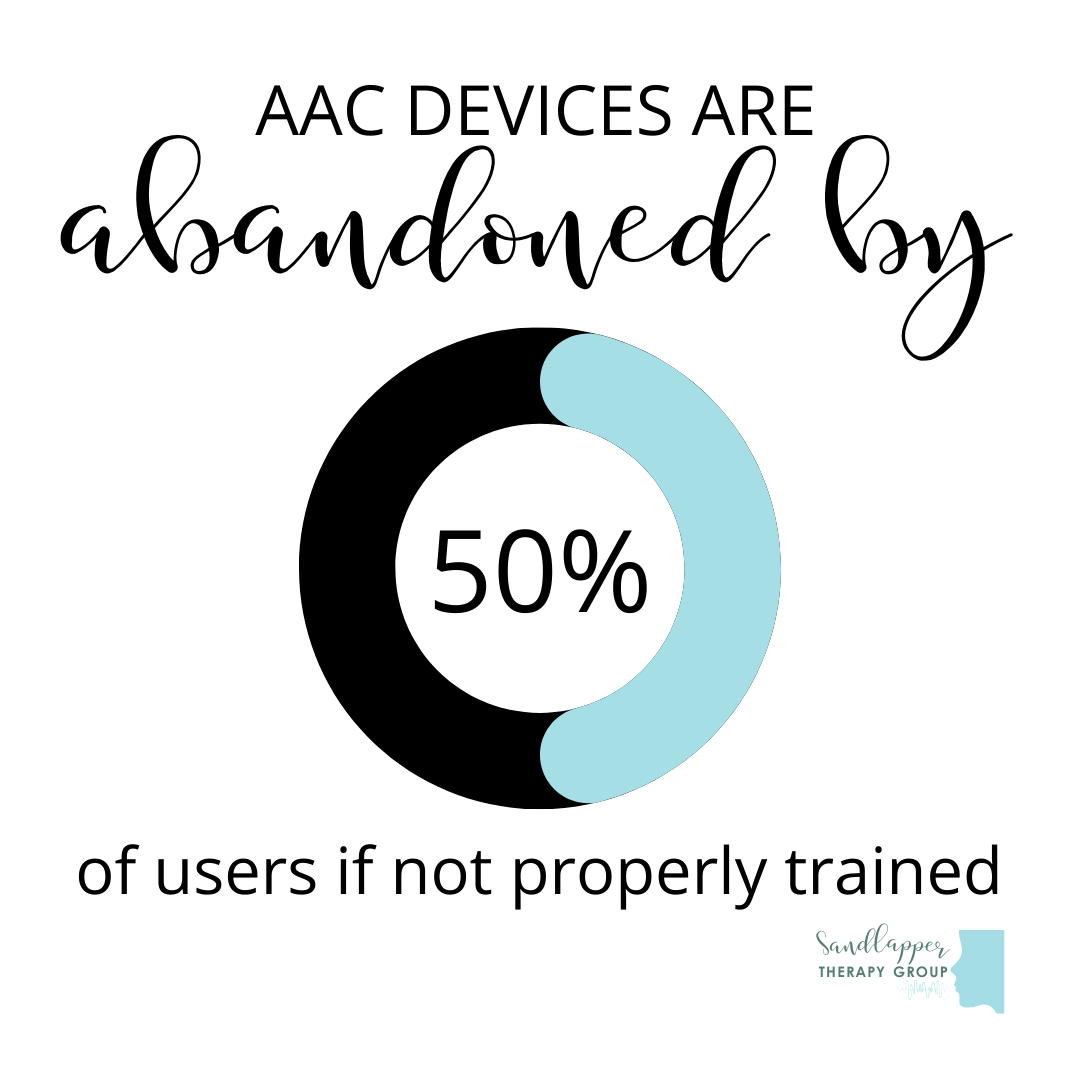
👉 Up to 50% of AAC devices are abandoned when users and communication partners are not properly trained.
That number is alarming — but it’s also preventable.
AAC can be life-changing. When implemented correctly, it gives children a reliable way to express their thoughts, needs, and personality. However, without appropriate support, even the best device can sit unused on a shelf.
Let’s talk about why AAC abandonment happens — and how speech-language pathologists can help ensure long-term success.
What Is AAC?
Augmentative and Alternative Communication (AAC) includes tools and strategies that support or replace spoken language. AAC may include:
Speech-generating devices
iPad-based communication apps
Communication boards
Picture exchange systems
Eye-gaze systems
Low-tech paper systems
According to the American Speech-Language-Hearing Association (ASHA), AAC supports individuals of all ages with complex communication needs and does not prevent speech development. In fact, research shows AAC often enhances speech and language growth.
Learn more from ASHA:
👉 https://www.asha.org/public/speech/disorders/aac/
Why Are AAC Devices Abandoned?
Research suggests that device abandonment can occur when:
The child is not properly trained on how to use the system
Parents and teachers are not trained to model language
The vocabulary system is too complex or poorly organized
The device is not consistently available
There is limited follow-up support
A foundational study by Johnson, Inglebret, Jones, & Ray (2006) found high rates of AAC device non-use when implementation lacked structured support and ongoing training.
More recent reviews emphasize that family involvement and communication partner training are critical for long-term AAC success (Light & McNaughton, 2014).
In short:
It’s not the device that fails — it’s the lack of training and implementation support.
The Role of Communication Partner Training
One of the strongest predictors of AAC success is how well adults are trained to model language.
AAC users learn language the same way speaking children do — by seeing it modeled repeatedly in meaningful interactions.
This strategy is called Aided Language Modeling.
Research shows that when caregivers and educators consistently model on the device:
Vocabulary grows
Spontaneous communication increases
Device use becomes functional
Abandonment rates decrease
ASHA’s Practice Portal highlights communication partner training as an essential component of AAC intervention:
👉 https://www.asha.org/practice-portal/clinical-topics/augmentative-and-alternative-communication/
AAC Does NOT Stop Speech
A common myth is that AAC prevents verbal speech.
Evidence consistently shows the opposite.
A landmark research review by Millar, Light, & Schlosser (2006) found that AAC interventions do not inhibit speech production and may actually increase spoken language in many children.
The National Institute on Deafness and Other Communication Disorders (NIDCD) also supports early intervention for children with communication disorders:
👉 https://www.nidcd.nih.gov/health/speech-and-language
AAC provides a bridge to communication — and communication builds language.
How Speech Therapy Prevents AAC Abandonment
A licensed speech-language pathologist (SLP) ensures:
1. Comprehensive Evaluation
Determining the right system based on motor skills, cognition, vision, hearing, and language level.
2. Individualized Vocabulary Selection
Core vocabulary systems are research-supported for flexible communication.
3. Parent and Teacher Training
Adults learn how to model language naturally during daily routines.
4. Ongoing Follow-Up
Vocabulary updates, goal adjustments, and troubleshooting.
5. Functional Integration
AAC is used across environments — home, school, and community.
Research consistently supports early, systematic AAC implementation with ongoing training to promote long-term use (Light & McNaughton, 2014).
Signs AAC Support May Be Needed
Consider consulting a speech-language pathologist if your child:
Has limited spoken language
Is frequently frustrated when communicating
Has a diagnosis such as autism, cerebral palsy, apraxia, or developmental delay
Has an AAC device that is rarely used
Uses only a few buttons on their device
Early support improves outcomes and reduces the risk of device abandonment.
The CDC’s “Learn the Signs. Act Early.” initiative encourages families to seek early intervention when communication concerns arise:
👉 https://www.cdc.gov/ncbddd/actearly
Final Thoughts
Yes, research shows that up to 50% of AAC devices may be abandoned without proper training.
But with:
Comprehensive evaluation
Consistent modeling
Caregiver training
Ongoing support
AAC becomes a powerful tool for connection, independence, and self-expression.
If your child has an AAC device that isn’t being used — or you’re considering AAC for the first time — we’re here to help. Contact our office today to schedule a comprehensive AAC consultation.
References
American Speech-Language-Hearing Association (ASHA). (2024). Augmentative and Alternative Communication Practice Portal. Retrieved from https://www.asha.org
Centers for Disease Control and Prevention (CDC). (2023). Learn the Signs. Act Early. Retrieved from https://www.cdc.gov/ncbddd/actearly
Johnson, J. M., Inglebret, E., Jones, C., & Ray, J. (2006). Perspectives of speech-language pathologists regarding success versus abandonment of AAC. Augmentative and Alternative Communication.
Light, J., & McNaughton, D. (2014). Communicative competence for individuals who require AAC: A new definition. Augmentative and Alternative Communication.
Millar, D. C., Light, J. C., & Schlosser, R. W. (2006). The impact of AAC intervention on speech production: A research review. Journal of Speech, Language, and Hearing Research.
National Institute on Deafness and Other Communication Disorders (NIDCD). (2023). Speech and Language Development. Retrieved from https://www.nidcd.nih.gov