
Sentence Structure Development Norms (36–48 Months): What to Expect in Preschool
Between 3 and 4 years old (36–48 months), children’s language explodes in both length and complexity. During this stage, toddlers move beyond short phrases and begin forming more grammatically complete sentences.
If you’re wondering whether your preschooler’s sentence development is on track, here’s what typical development looks like — and when to consider a speech-language evaluation.
Why Sentence Structure Matters
Sentence structure, also known as syntax, refers to how words are organized to create meaningful sentences.
Strong sentence development supports:
Clear communication
Storytelling abilities
Social interaction
Kindergarten readiness
Early reading and writing skills
The American Speech-Language-Hearing Association (ASHA) explains that expressive language development during preschool years lays the foundation for later academic success.
Learn more here:
👉 https://www.asha.org/public/speech/development/language/
Sentence Structure Milestones: 36–48 Months
During this stage, children begin producing more complete and grammatically accurate sentences.
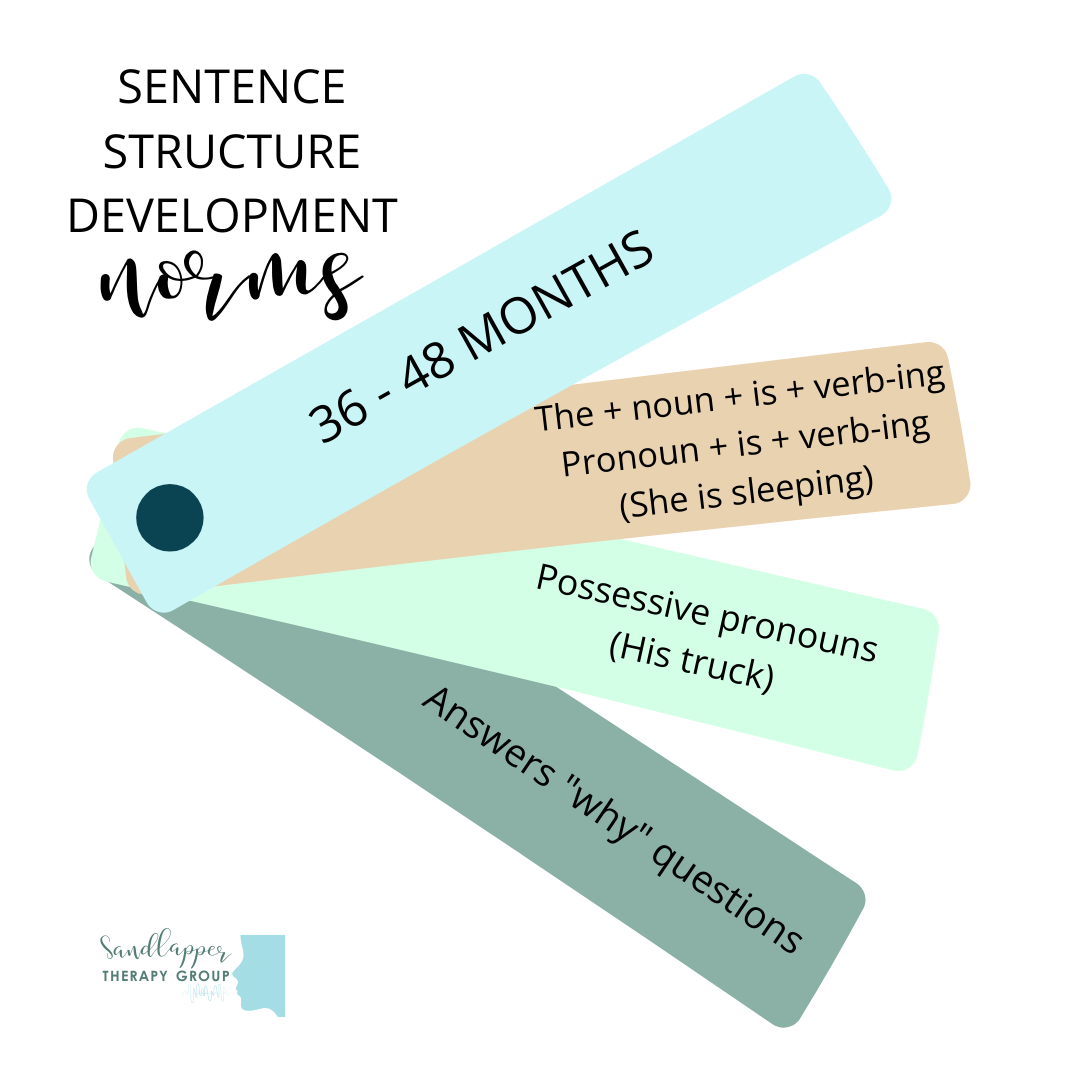
1. The + Noun + Is + Verb-ing
Children begin using articles and auxiliary verbs together.
Examples:
“The dog is barking.”
“The baby is crying.”
This reflects growth in grammatical markers and aligns with Brown’s Stage IV–V of language development (Brown, 1973).
2. Pronoun + Is + Verb-ing
Examples:
“She is sleeping.”
“He is running.”
Children begin using pronouns correctly in subject position, paired with auxiliary verbs.
3. Possessive Pronouns
Children begin using possessive pronouns to show ownership.
Examples:
“His truck.”
“Her shoes.”
“My turn.”
Correct pronoun use is an important marker of grammatical development.
4. Answering “Why” Questions
By 3–4 years old, children begin answering simple “why” questions, even if their responses are brief or incomplete.
Examples:
“Why is he crying?”
→ “Because he fell.”“Why do we wear coats?”
→ “It’s cold.”
This reflects growing reasoning skills and expressive language complexity.
How Sentence Length Expands
During this stage, children typically produce:
4–5 word sentences
Increasing use of grammatical markers
More complex sentence combinations
Speech-language pathologists often measure this growth using Mean Length of Utterance (MLU), which continues to increase during the preschool years.
ASHA identifies conversational language sampling and grammatical analysis as critical components of language evaluation:
👉 https://www.asha.org/practice-portal/clinical-topics/spoken-language-disorders/
Typical vs. Concerning Patterns
It’s normal for preschoolers to:
Occasionally omit small words
Make minor grammar errors
Simplify complex sentences
However, consider a speech-language evaluation if your child:
Uses mostly short, 2–3 word sentences
Struggles to use pronouns appropriately
Rarely answers “why” questions
Leaves out auxiliary verbs (“He running” instead of “He is running”)
Has difficulty being understood
The CDC’s “Learn the Signs. Act Early.” initiative encourages parents to seek early support when developmental concerns arise:
👉 https://www.cdc.gov/ncbddd/actearly
Evidence-Based Language Intervention
Speech therapy targeting sentence structure may include:
Expansion and recasting (modeling longer versions of the child’s sentence)
Focused stimulation of grammatical targets
Enhanced Milieu Teaching (EMT)
Structured play-based language modeling
Parent coaching for daily carryover
Research supports naturalistic, caregiver-involved intervention approaches for improving expressive language outcomes (Roberts & Kaiser, 2011).
Early, consistent intervention improves long-term communication and academic success.
What Happens During a Language Evaluation?
A comprehensive expressive language evaluation may include:
Standardized testing
Conversational language sampling
MLU calculation
Observation of play and interaction
Parent interview
This helps determine whether your child’s sentence structure is developing within typical norms.
Final Thoughts
Between 36–48 months, children should begin:
Using full sentences like “The dog is barking”
Correctly using pronouns such as “he” and “she”
Demonstrating possessive pronouns like “his” and “her”
Answering simple “why” questions
If your child’s sentence structure seems limited compared to peers, early speech-language support can make a meaningful difference.
If you have concerns about your preschooler’s language development, contact our office today to schedule a comprehensive speech-language evaluation.
References
American Speech-Language-Hearing Association (ASHA). (2024). Spoken Language Disorders Practice Portal. Retrieved from https://www.asha.org
Brown, R. (1973). A First Language: The Early Stages. Harvard University Press.
Centers for Disease Control and Prevention (CDC). (2023). Learn the Signs. Act Early. Retrieved from https://www.cdc.gov/ncbddd/actearly
National Institute on Deafness and Other Communication Disorders (NIDCD). (2023). Speech and Language Development. Retrieved from https://www.nidcd.nih.gov
Roberts, M. Y., & Kaiser, A. P. (2011). The effectiveness of parent-implemented language interventions. American Journal of Speech-Language Pathology.