
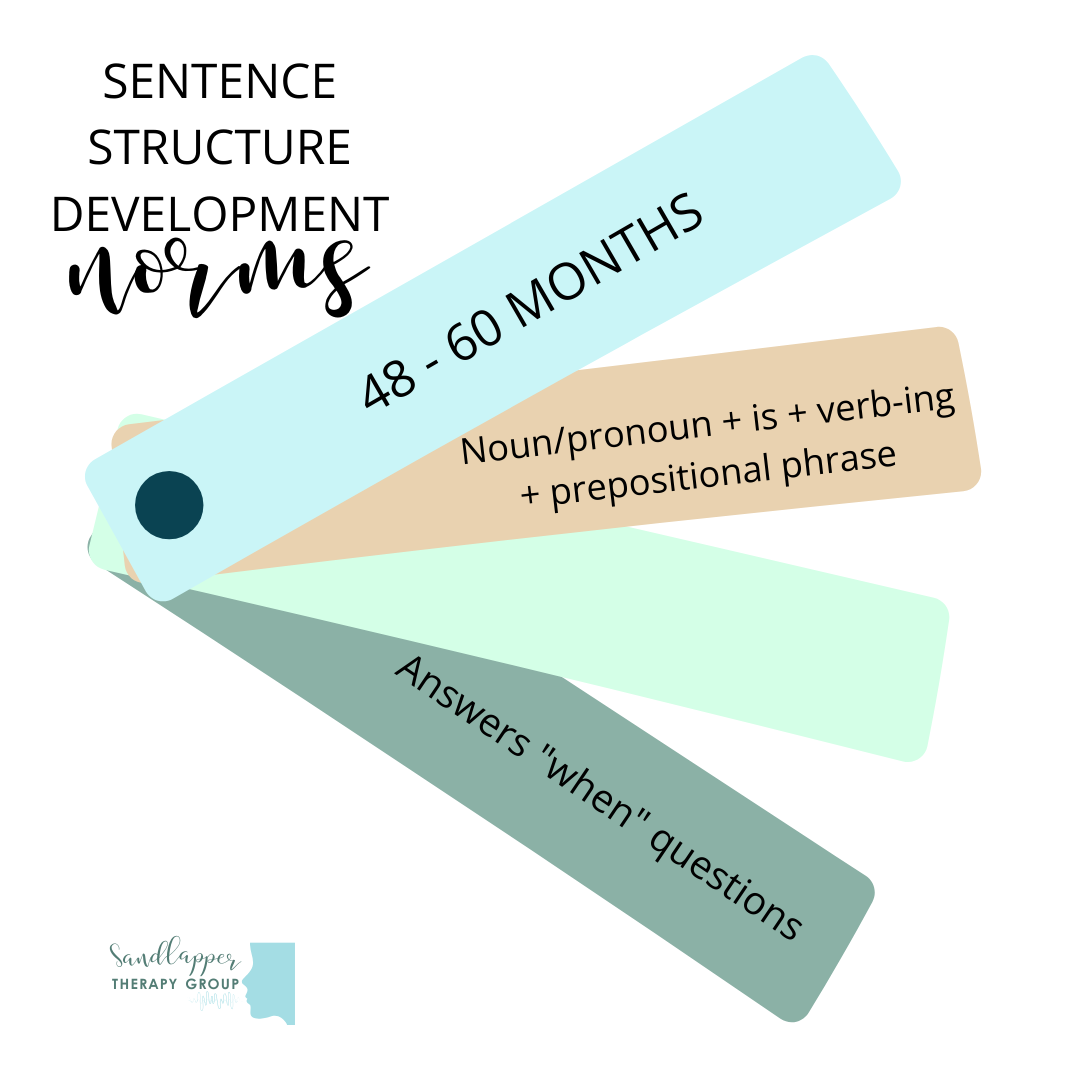
Sentence Structure Development Norms (48–60 Months): What to Expect Before Kindergarten
Between 4 and 5 years old (48–60 months), children’s language becomes more detailed, organized, and grammatically complete. During this stage, preschoolers begin forming longer sentences that include multiple parts — preparing them for kindergarten conversations, storytelling, and classroom learning.
If you’re wondering whether your child’s sentence structure is on track, here’s what typical development looks like — and when to consider a speech-language evaluation.
Why Sentence Structure Matters
Sentence structure (also called syntax) refers to how words are arranged to form complete thoughts. Strong sentence development supports:
Reading readiness
Writing skills
Listening comprehension
Peer interaction
Academic success
The American Speech-Language-Hearing Association (ASHA) explains that preschool language development is a critical predictor of later literacy and school performance.
Learn more here:
👉 https://www.asha.org/public/speech/development/language/
Sentence Structure Milestones: 48–60 Months
By 4–5 years old, children begin combining multiple grammatical elements into longer, more complex sentences.
1. Noun/Pronoun + Is + Verb-ing + Prepositional Phrase
Children can combine subjects, auxiliary verbs, action words, and location phrases.
Examples:
“The dog is running in the yard.”
“She is sleeping on the couch.”
“He is playing at the park.”
This reflects development consistent with later stages of Brown’s Stages of Language Development, where grammatical complexity increases significantly (Brown, 1973).
2. Use of Prepositional Phrases
Prepositions describe location or time.
Examples:
in
on
under
next to
behind
By this age, children should use prepositions accurately in sentences rather than as isolated words.
3. Answering “When” Questions
Children begin answering “when” questions, which require understanding of time concepts.
Examples:
“When do we go to school?” → “In the morning.”
“When do you wear pajamas?” → “At night.”
Answering “when” questions demonstrates growth in both sentence structure and abstract language understanding.
Expanding Sentence Length and Complexity
During this stage, children typically:
Use 5–6 word sentences
Combine multiple ideas
Use correct pronouns
Use auxiliary verbs consistently
Add descriptive details
Speech-language pathologists often assess these skills using language sampling and Mean Length of Utterance (MLU).
ASHA identifies language sampling as an essential component of evaluating spoken language disorders:
👉 https://www.asha.org/practice-portal/clinical-topics/spoken-language-disorders/
Typical Errors vs. Red Flags
It is typical for 4–5-year-olds to:
Occasionally misuse irregular grammar
Make minor pronoun errors
Simplify complex sentences
However, consider an evaluation if your child:
Uses mostly short 2–3 word phrases
Struggles to combine verbs and prepositions
Rarely answers “when” questions
Omits auxiliary verbs (“She sleeping” instead of “She is sleeping”)
Has difficulty telling simple stories
The CDC’s “Learn the Signs. Act Early.” program encourages parents to seek early support when developmental concerns arise:
👉 https://www.cdc.gov/ncbddd/actearly
Evidence-Based Language Intervention
Speech therapy targeting sentence structure may include:
Expansion and recasting (modeling longer, grammatically correct versions of the child’s sentences)
Focused stimulation of grammatical targets
Enhanced Milieu Teaching (EMT)
Narrative-based language intervention
Parent coaching for daily practice
A meta-analysis by Roberts & Kaiser (2011) found that parent-implemented language interventions significantly improve expressive language outcomes.
Research consistently supports early, naturalistic, caregiver-involved intervention approaches.
Preparing for Kindergarten
By age 5, children should be able to:
Use grammatically complete sentences
Answer who, what, where, when, and why questions
Describe events with multiple details
Participate in back-and-forth conversations
The National Institute on Deafness and Other Communication Disorders (NIDCD) emphasizes that strong early language skills are foundational for literacy and academic success:
👉 https://www.nidcd.nih.gov/health/speech-and-language
When to Schedule a Language Evaluation
Consider a speech-language evaluation if your 4–5-year-old:
Has significantly shorter sentences than peers
Avoids answering questions
Has difficulty combining ideas
Struggles to use correct grammar consistently
Is difficult to understand
A comprehensive evaluation includes standardized testing, language sampling, and analysis of sentence structure and grammar.
Final Thoughts
Between 48–60 months, children should:
Combine noun/pronoun + is + verb-ing
Add prepositional phrases
Answer “when” questions
Use longer, more detailed sentences
If your child’s sentence development seems limited compared to peers, early speech-language support can make a meaningful difference in communication and academic readiness.
If you have concerns about your child’s language development, contact our office today to schedule a comprehensive speech-language evaluation.
References
American Speech-Language-Hearing Association (ASHA). (2024). Spoken Language Disorders Practice Portal. Retrieved from https://www.asha.org
Brown, R. (1973). A First Language: The Early Stages. Harvard University Press.
Centers for Disease Control and Prevention (CDC). (2023). Learn the Signs. Act Early. Retrieved from https://www.cdc.gov/ncbddd/actearly
National Institute on Deafness and Other Communication Disorders (NIDCD). (2023). Speech and Language Development. Retrieved from https://www.nidcd.nih.gov
Roberts, M. Y., & Kaiser, A. P. (2011). The effectiveness of parent-implemented language interventions. American Journal of Speech-Language Pathology.