
Answering Questions Development: What to Expect from 1 to 4 Years
The ability to answer questions is a major milestone in early language development. It shows that a child can understand spoken language, process information, and respond appropriately. From simple yes/no responses to answering “why” and “when” questions, these skills build the foundation for classroom learning and social communication.
If you’re wondering whether your child’s comprehension and answering skills are on track, this guide outlines typical developmental norms from ages 1–4.
Why Answering Questions Matters
Answering questions requires several language skills working together:
Receptive language (understanding what was asked)
Attention and listening
Vocabulary knowledge
Sentence structure
Reasoning skills
The American Speech-Language-Hearing Association (ASHA) identifies understanding and responding to questions as a key component of language comprehension and school readiness.
Learn more here:
👉 https://www.asha.org/public/speech/development/language/
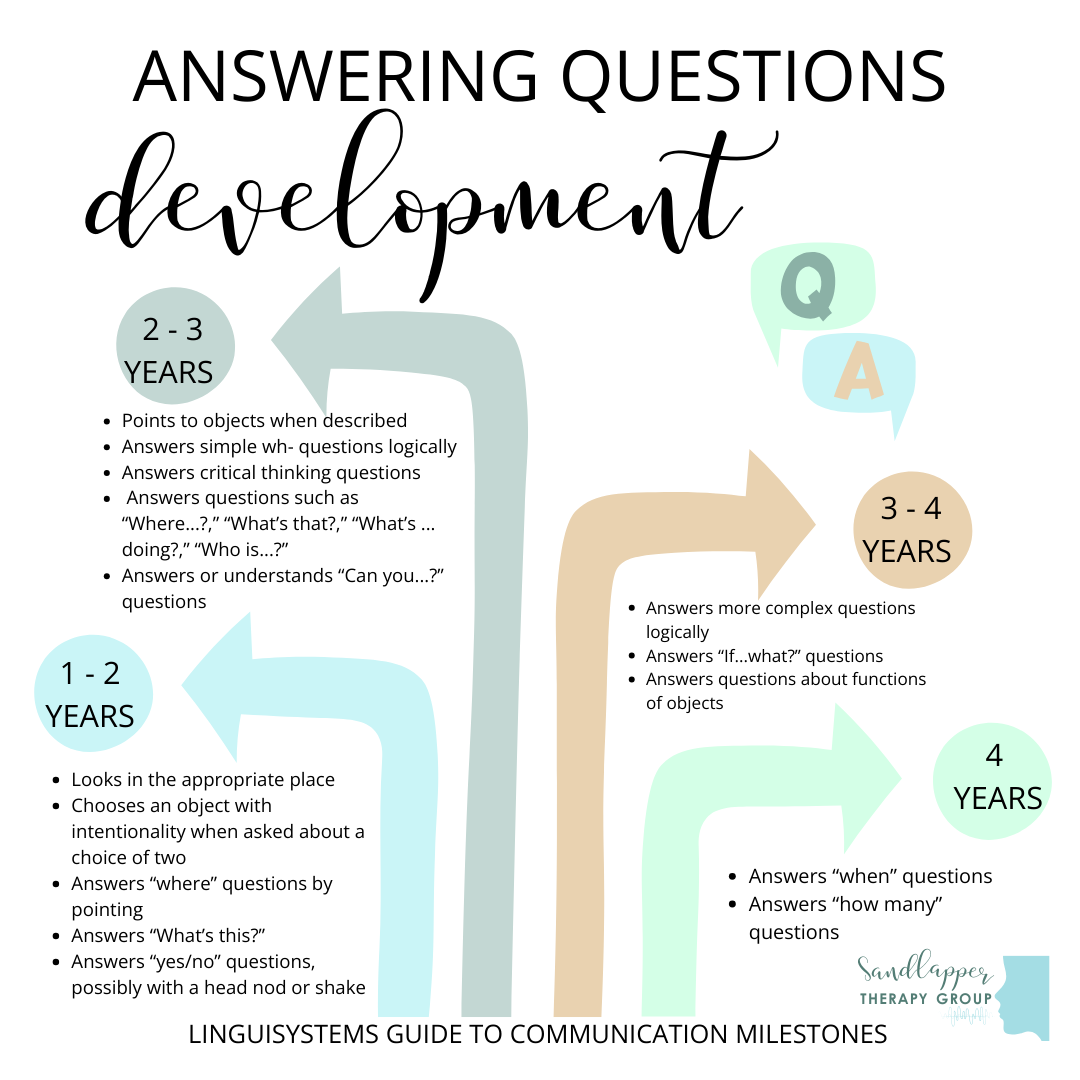
Answering Questions Milestones by Age
1–2 Years
At this stage, children begin responding to very simple questions.
Typical skills:
Looks in the appropriate place when asked about something
Chooses between two objects when asked
Answers “where” questions by pointing
Answers “What’s this?” questions
Responds to yes/no questions (sometimes with a head nod or shake)
Examples:
“Where’s your shoe?” → Child points
“Is this a dog?” → Head nod
These early responses often rely on gestures rather than full sentences — and that’s developmentally appropriate.
2–3 Years
Between 24 and 36 months, children begin answering simple wh-questions more logically.
Typical skills:
Points to objects when described
Answers simple “where,” “what,” and “who” questions
Answers “What’s he doing?”
Understands or answers simple “Can you…?” questions
Examples:
“Where’s mommy?” → “Work.”
“What is he doing?” → “Running.”
Children at this age may still give one- or two-word answers, which is typical.
ASHA notes that toddlers at this stage rapidly expand both vocabulary and sentence length.
👉 https://www.asha.org/practice-portal/clinical-topics/spoken-language-disorders/
3–4 Years
Preschoolers begin answering more complex questions and demonstrating reasoning skills.
Typical skills:
Answers more complex questions logically
Answers “If…what?” questions
Answers questions about functions of objects
Examples:
“What do we use to cut paper?” → “Scissors.”
“If you’re tired, what do you do?” → “Sleep.”
This stage shows growth in comprehension, abstract thinking, and vocabulary.
4 Years
By age 4, children should answer a wider variety of question types.
Typical skills:
Answers “when” questions
Answers “how many” questions
Understands time concepts like morning and night
Provides more detailed responses
Examples:
“When do we go to school?” → “In the morning.”
“How many apples?” → “Three.”
The CDC’s Learn the Signs. Act Early. program highlights answering questions as a key preschool milestone:
👉 https://www.cdc.gov/ncbddd/actearly
Why These Skills Matter for School
Answering questions is critical for:
Following classroom directions
Participating in group discussions
Reading comprehension
Math problem-solving
Social problem-solving
The National Institute on Deafness and Other Communication Disorders (NIDCD) emphasizes that early language comprehension strongly predicts academic success.
👉 https://www.nidcd.nih.gov/health/speech-and-language
Children who struggle to answer questions may appear inattentive when, in reality, they are having difficulty processing language.
When to Be Concerned
Consider a speech-language evaluation if your child:
Rarely responds to questions
Frequently gives unrelated answers
Cannot answer basic “who,” “what,” or “where” questions by age 3
Struggles with “when” or “how many” questions by age 4
Appears confused when asked simple questions
Difficulty answering questions may indicate a receptive language delay, auditory processing challenges, or broader language disorder.
Evidence-Based Intervention
Speech therapy for answering questions may include:
Structured WH-question practice
Visual supports and cueing strategies
Modeling and expansion
Category and function training
Play-based comprehension activities
Parent coaching for home carryover
Research supports caregiver-implemented language interventions and naturalistic approaches for improving receptive and expressive language skills (Roberts & Kaiser, 2011).
Early intervention leads to stronger long-term academic outcomes.
Final Thoughts
Answering questions develops gradually:
1–2 years: Points and answers yes/no
2–3 years: Answers simple “where” and “what” questions
3–4 years: Answers function and reasoning questions
4 years: Answers “when” and “how many” questions
If your child is not meeting these milestones, early speech-language support can significantly improve comprehension and confidence.
If you have concerns about your child’s language development, contact our office today to schedule a comprehensive speech-language evaluation.
References
American Speech-Language-Hearing Association (ASHA). (2024). Spoken Language Disorders Practice Portal. Retrieved from https://www.asha.org
Centers for Disease Control and Prevention (CDC). (2023). Learn the Signs. Act Early. Retrieved from https://www.cdc.gov/ncbddd/actearly
National Institute on Deafness and Other Communication Disorders (NIDCD). (2023). Speech and Language Development. Retrieved from https://www.nidcd.nih.gov
Roberts, M. Y., & Kaiser, A. P. (2011). The effectiveness of parent-implemented language interventions. American Journal of Speech-Language Pathology.