
Receptive Vocabulary Milestones: What to Expect from 12–36 Months
Before children can say hundreds of words, they understand them. Receptive vocabulary refers to the words a child understands — even if they can’t say them yet. In fact, children typically understand far more words than they can express.
If you're wondering whether your toddler understands language at an age-appropriate level, this guide outlines typical receptive vocabulary milestones from 12 to 36 months, along with when to consider a speech-language evaluation.
What Is Receptive Vocabulary?
Receptive vocabulary is the number of words a child understands when heard in context. This includes:
Object names
Action words
Descriptive words
Simple directions
Social language
The American Speech-Language-Hearing Association (ASHA) explains that receptive language skills form the foundation for expressive language, reading comprehension, and academic success.
Learn more here:
👉 https://www.asha.org/public/speech/development/language/
Receptive Vocabulary Milestones by Age
The following milestones reflect typical development. Some variation is normal, but significant delays may indicate a need for evaluation.
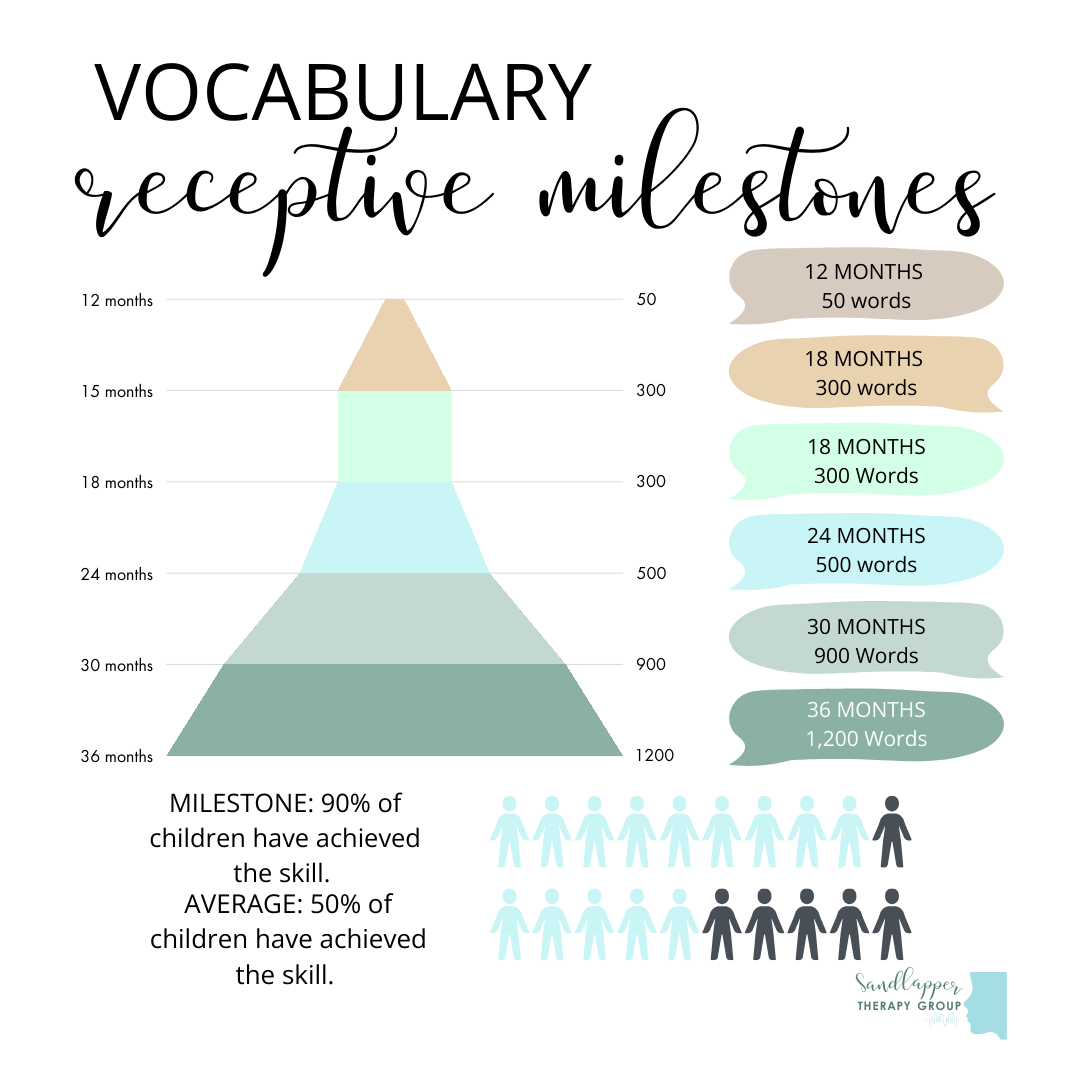
12 Months
Understands approximately 50 words
Examples:
Name recognition
Common objects (ball, cup, shoe)
Familiar routines (bath, bye-bye)
Children may not say these words yet but respond appropriately when they hear them.
18 Months
Understands approximately 300 words
By 18 months, receptive vocabulary grows rapidly. Children can:
Follow simple one-step directions
Identify body parts
Recognize familiar objects in books
Respond to simple questions like “Where’s the dog?”
The CDC’s Learn the Signs. Act Early. program notes that toddlers should follow simple directions and understand common words by this age.
👉 https://www.cdc.gov/ncbddd/actearly
24 Months (2 Years)
Understands approximately 500 words
At age 2, toddlers typically:
Follow two-step directions
Understand common verbs
Respond to “where” and “what” questions
Identify objects by function
ASHA identifies comprehension of multi-word directions as an important developmental milestone by age 2.
👉 https://www.asha.org/practice-portal/clinical-topics/spoken-language-disorders/
30 Months
Understands approximately 900 words
Children at this stage demonstrate:
Understanding of descriptive concepts (big/little)
Recognition of categories
Ability to follow more complex instructions
Vocabulary comprehension expands significantly as children prepare for preschool.
36 Months (3 Years)
Understands approximately 1,200 words
By age 3, children typically:
Understand spatial concepts
Follow multi-step directions
Answer simple “why” and “how” questions
Understand basic time concepts
A receptive vocabulary of around 1,200 words supports classroom readiness and social communication.
Milestone vs. Average
Developmental charts often show:
Milestone (90%): 90% of children have achieved this level
Average (50%): 50% of children have achieved this level
If your child is significantly below milestone expectations, early evaluation is recommended.
Why Receptive Vocabulary Matters
Strong receptive vocabulary supports:
Listening comprehension
Reading readiness
Sentence structure development
Social understanding
Following classroom instructions
The National Institute on Deafness and Other Communication Disorders (NIDCD) emphasizes that early language comprehension predicts long-term academic outcomes.
👉 https://www.nidcd.nih.gov/health/speech-and-language
Children who struggle with receptive language may appear inattentive or oppositional when they actually do not understand instructions.
Signs Your Child May Need Support
Consider a speech-language evaluation if your child:
Does not respond to their name consistently
Struggles to follow simple directions by 18–24 months
Does not understand common objects or routines
Frequently seems confused by questions
Shows frustration during communication
Receptive language delays often occur alongside expressive delays but can also occur independently.
Evidence-Based Intervention
Speech therapy for receptive vocabulary may include:
Play-based language enrichment
Repetition within daily routines
Visual supports and modeling
Structured direction-following activities
Parent coaching for home carryover
Research supports caregiver-implemented language intervention as effective for improving vocabulary and comprehension skills (Roberts & Kaiser, 2011).
Early intervention leads to improved academic and communication outcomes.
Final Thoughts
Receptive vocabulary develops rapidly between 12 and 36 months:
12 months: ~50 words understood
18 months: ~300 words
24 months: ~500 words
30 months: ~900 words
36 months: ~1,200 words
If your child struggles to understand directions or questions, early speech-language support can make a meaningful difference.
If you have concerns about your child’s speech or language development, contact our office today to schedule a comprehensive evaluation.
References
American Speech-Language-Hearing Association (ASHA). (2024). Language Development Milestones. Retrieved from https://www.asha.org
Centers for Disease Control and Prevention (CDC). (2023). Learn the Signs. Act Early. Retrieved from https://www.cdc.gov/ncbddd/actearly
National Institute on Deafness and Other Communication Disorders (NIDCD). (2023). Speech and Language Development. Retrieved from https://www.nidcd.nih.gov
Roberts, M. Y., & Kaiser, A. P. (2011). The effectiveness of parent-implemented language interventions. American Journal of Speech-Language Pathology.