
Basic Concepts Development: A Guide for Parents and Educators
Understanding basic concepts is a critical part of early childhood development. These concepts form the foundation for listening comprehension, academic success, and everyday communication. In speech therapy, we frequently assess and target basic concept development because difficulties in this area can impact reading, math, following directions, and classroom learning.
According to the American Speech-Language-Hearing Association (ASHA), concept development is closely tied to language comprehension and cognitive growth. When children struggle to understand early concepts, they may appear inattentive or confused — when in reality, they may not fully grasp the vocabulary being used.
👉 https://www.asha.org/public/speech/development/
Let’s walk through how basic concepts typically develop from toddlerhood through early elementary years.
What Are “Basic Concepts”?
Basic concepts include understanding words that describe:
Quantity (one, many, empty, more)
Size (big, small, bigger)
Time (yesterday, tomorrow, first, next)
Position (middle, last)
Comparison (same, different)
Order (first, second, third)
Descriptive qualities (thin, whole)
Direction (forward, backward)
These words may seem simple, but they are essential for:
Following classroom directions
Understanding stories
Solving math problems
Participating in conversations
Reading comprehension
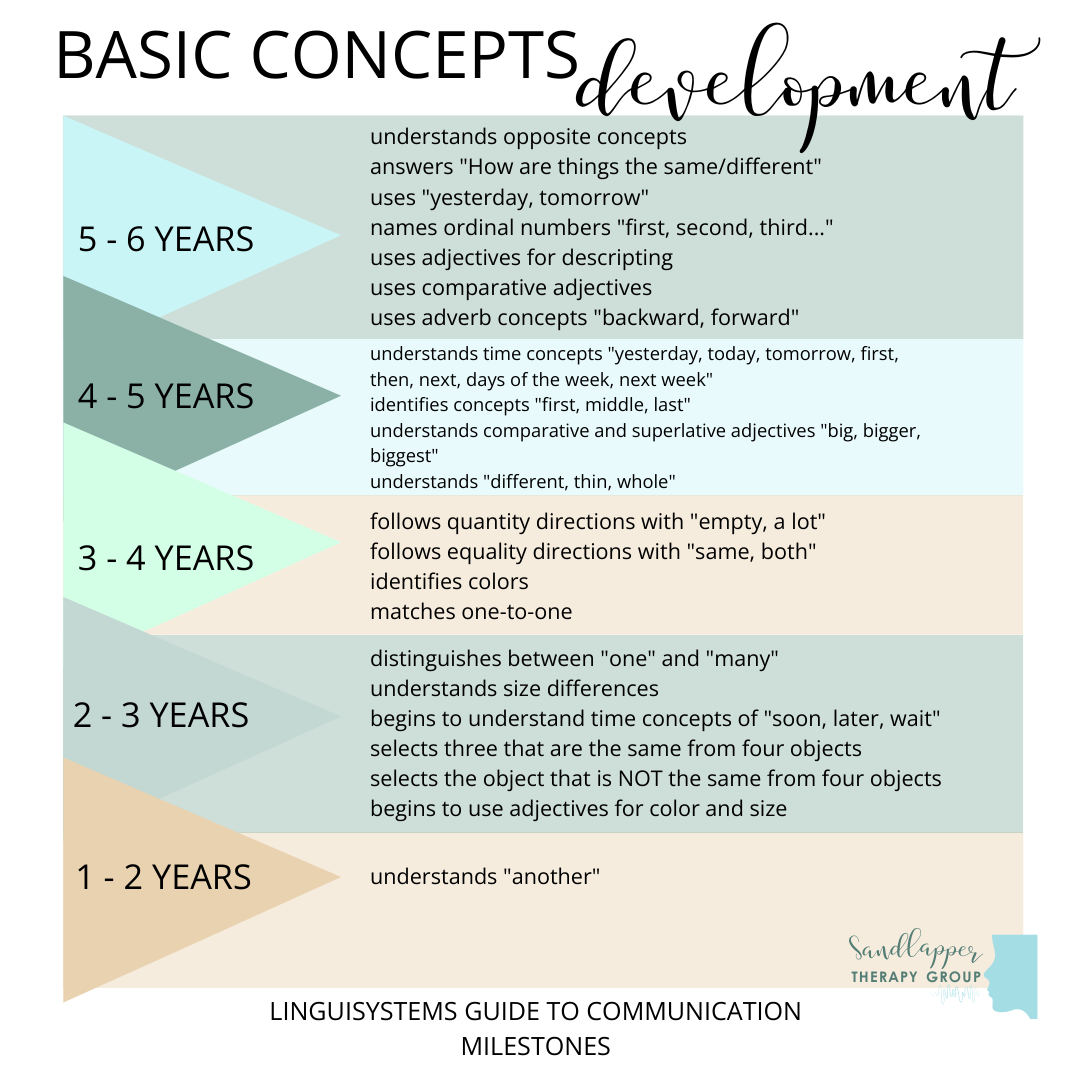
Basic Concepts Development by Age
1–2 Years
Children begin to understand simple relational concepts such as:
“Another”
At this stage, toddlers are learning through repetition and daily routines.
2–3 Years
Children begin to:
Distinguish between “one” and “many”
Understand size differences
Begin understanding time concepts like “soon,” “later,” and “wait”
Select three objects that are the same from four
Identify the object that does NOT belong
Begin using adjectives for color and size
These skills lay the groundwork for sorting, categorizing, and early math concepts.
3–4 Years
Children typically:
Follow quantity directions like “empty” or “a lot”
Follow equality directions such as “same” and “both”
Identify colors
Match objects one-to-one
This stage supports preschool readiness and early academic participation.
4–5 Years
Children expand their understanding of:
Time concepts (yesterday, today, tomorrow, first, then, next)
Days of the week and next week
Positional concepts (first, middle, last)
Comparative and superlative adjectives (big, bigger, biggest)
Descriptive words such as “different,” “thin,” and “whole”
At this age, children begin applying these concepts in classroom settings.
5–6 Years
By kindergarten and first grade, children often:
Understand opposite concepts
Answer comparison questions (“How are these the same or different?”)
Use time words like “yesterday” and “tomorrow” correctly
Name ordinal numbers (first, second, third)
Use descriptive and comparative adjectives
Understand directional adverbs like “forward” and “backward”
Mastery of these concepts strongly supports reading comprehension and math problem-solving.
Why Basic Concepts Matter for School Success
Research consistently shows that early concept knowledge predicts later academic achievement, particularly in reading and math.
Children who struggle with basic concepts may:
Misinterpret directions
Have difficulty understanding story problems
Struggle with reading comprehension
Appear inattentive in class
Avoid participating in group activities
ASHA highlights the importance of strong receptive language skills (understanding language) for overall academic success.
👉 https://www.asha.org/practice-portal/clinical-topics/spoken-language-disorders/
Signs a Child May Need Support
Consider a speech-language evaluation if your child:
Frequently misunderstands directions
Has difficulty with “same/different” tasks
Struggles with time-related words
Cannot follow multi-step directions
Has trouble with comparison or descriptive language
Appears confused during classroom activities
Children with Developmental Language Disorder (DLD), speech delays, ADHD, or learning disabilities often have difficulty with concept development.
How Speech Therapy Supports Basic Concepts
Speech-language pathologists use evidence-based interventions to teach and reinforce concepts through:
Play-based learning
Visual supports
Sorting and categorization activities
Story-based instruction
Explicit teaching of comparison language
Multi-sensory activities
Systematic, explicit instruction of vocabulary and concepts has strong research support for improving comprehension (Justice et al., 2018).
How Parents Can Support Concept Development at Home
✔ Use descriptive language during everyday routines
✔ Compare objects (“This one is bigger.”)
✔ Ask “same or different?” questions
✔ Talk about time concepts daily
✔ Practice sorting laundry or toys
✔ Read books and highlight descriptive words
The CDC’s Learn the Signs. Act Early. program provides developmental milestone checklists that include concept development indicators.
👉 https://www.cdc.gov/ncbddd/actearly/
The Connection Between Basic Concepts and Literacy
Basic concepts are foundational for:
Reading comprehension
Understanding story sequence
Math problem-solving
Written expression
The National Reading Panel emphasizes vocabulary and language comprehension as pillars of literacy development.
👉 https://www.nichd.nih.gov/publications/pubs/nrp
Strong concept knowledge supports children in understanding directions like:
“Circle the biggest number.”
“Underline the second sentence.”
“Put an X on the object that does not belong.”
Final Thoughts
Basic concepts may seem simple, but they are essential building blocks for communication and academic success.
From understanding “another” in toddlerhood to mastering comparative adjectives and ordinal numbers in early elementary years, each stage builds on the last.
If you are concerned about your child’s understanding of concepts or ability to follow directions, early speech therapy intervention can make a meaningful difference.
Contact our office today to schedule a comprehensive speech and language evaluation.
References
American Speech-Language-Hearing Association (ASHA). (2024). Speech and Language Development Milestones. Retrieved from https://www.asha.org
American Speech-Language-Hearing Association (ASHA). (2024). Spoken Language Disorders Practice Portal. Retrieved from https://www.asha.org/practice-portal/clinical-topics/spoken-language-disorders/
Centers for Disease Control and Prevention (CDC). (2023). Learn the Signs. Act Early. Retrieved from https://www.cdc.gov/ncbddd/actearly
Justice, L. M., et al. (2018). Explicit vocabulary instruction and language outcomes. American Journal of Speech-Language Pathology.
National Reading Panel. (2000). Teaching Children to Read. National Institute of Child Health and Human Development. Retrieved from https://www.nichd.nih.gov/publications/pubs/nrp