
By Age 4, Your Child Should Be Understood About 50% of the Time: What That Really Means
One of the most common questions parents ask is:
“Is my child’s speech clear enough for their age?”
A helpful rule of thumb used in speech-language pathology is this:
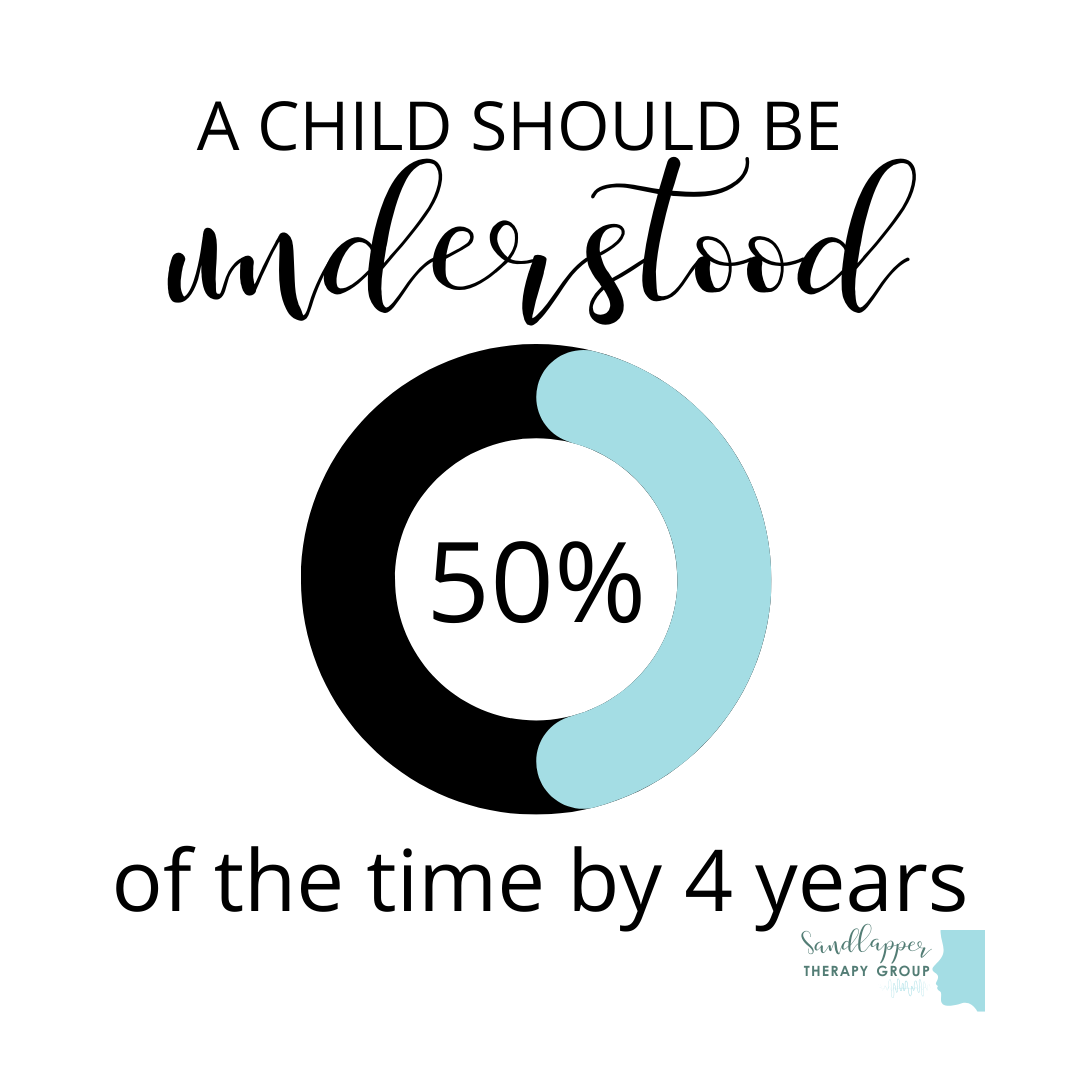
👉 By age 4, a child should be understood about 50% of the time by unfamiliar listeners.
This benchmark helps parents and professionals determine whether speech development is on track — or whether a speech evaluation may be needed.
Let’s break down what this means and why it matters.
What Does “50% Intelligible” Mean?
When we say a child should be understood 50% of the time, we are referring to speech intelligibility — the percentage of speech that can be understood by someone who does not know the child well.
An unfamiliar listener might include:
A teacher
A coach
A peer
A family friend
A medical provider
Parents often understand their child better because they are used to their speech patterns. That’s why intelligibility to unfamiliar listeners is an important developmental marker.
According to classic developmental research (Coplan & Gleason, 1988) and commonly referenced clinical guidelines, speech intelligibility expectations increase steadily during early childhood:
Age 3: ~50% intelligible
Age 4: ~75% intelligible
Age 5: ~90% intelligible
However, many simplified parent guidelines reference the “rule of fours” — meaning a 4-year-old’s speech should be understood about 4/4 (close to 100%) by familiar listeners and approximately 50–75% by unfamiliar listeners, depending on the model referenced.
Because research varies slightly across studies, it’s important to view 50% as a minimum developmental benchmark, not an upper limit.
Why Speech Intelligibility Matters
Clear speech affects more than just pronunciation. It impacts:
Classroom participation
Peer relationships
Confidence and self-esteem
Early reading and spelling skills
The American Speech-Language-Hearing Association (ASHA) notes that speech sound disorders can affect social, academic, and emotional development if left untreated.
Learn more from ASHA:
👉 https://www.asha.org/public/speech/disorders/speech-sound-disorders/
Research also shows that early speech sound disorders are associated with later literacy challenges (Lewis et al., 2000; Peterson et al., 2009). Speech clarity supports phonological awareness — a foundational reading skill.
The CDC’s “Learn the Signs. Act Early.” program encourages parents to address concerns early rather than adopting a “wait and see” approach:
👉 https://www.cdc.gov/ncbddd/actearly
What Is Typical at Age 4?
At 4 years old, many children:
Still make some sound errors (e.g., /r/, /l/, /th/ may not be mastered yet)
May simplify longer words
Occasionally substitute sounds
However, by age 4:
Speech should be understandable most of the time
Strangers should grasp at least half of what the child says
Frequent communication breakdowns are not typical
If your child is difficult for teachers or peers to understand, that may indicate a speech sound disorder.
What Can Affect Intelligibility?
Reduced intelligibility may be related to:
Articulation Disorders
Difficulty producing specific sounds correctly.
Phonological Disorders
Patterns of sound errors (e.g., “tat” for “cat”).
Childhood Apraxia of Speech
A motor planning disorder affecting speech coordination.
Hearing Differences
Hearing plays a critical role in sound development.
ASHA outlines these categories within its Practice Portal for Articulation and Phonology:
👉 https://www.asha.org/practice-portal/clinical-topics/articulation-and-phonology/
Evidence-Based Speech Therapy
If a child’s intelligibility is below developmental expectations, early intervention is highly effective.
Research-supported treatment approaches include:
Motor-based articulation therapy grounded in principles of motor learning (Maas et al., 2008)
Phonological contrast therapy to address sound patterns (Gierut, 2001)
Cycles approach for multiple sound errors (Hodson, 2010)
Parent coaching models to improve carryover at home
A 2021 longitudinal study published in the Journal of Speech, Language, and Hearing Research demonstrated that speech intelligibility improves significantly with structured, targeted intervention (Hustad et al., 2021).
Early therapy not only improves clarity but also prevents secondary impacts on literacy and confidence.
When Should You Schedule an Evaluation?
Consider a speech-language evaluation if your 4-year-old:
Is understood less than half the time by unfamiliar listeners
Becomes frustrated when trying to communicate
Avoids speaking in groups
Has frequent sound substitutions
Is difficult for preschool teachers to understand
A comprehensive evaluation can determine whether speech development is within expected range or if therapy is recommended.
What Happens During a Speech Evaluation?
A pediatric speech evaluation typically includes:
Standardized articulation and phonology assessments
Intelligibility measures
Oral motor examination
Hearing screening referral if needed
Parent and teacher input
Individualized treatment recommendations
Speech therapy for preschoolers is play-based, engaging, and tailored to the child’s developmental level.
Final Thoughts
By age 4, a child should be understood at least 50% of the time by unfamiliar listeners — and often closer to 75%.
If your child’s speech is significantly harder to understand, early support can make a meaningful difference in communication, confidence, and academic readiness.
If you’re concerned about your child’s speech clarity, our team is here to help. Contact us today to schedule a comprehensive speech-language evaluation.
References
American Speech-Language-Hearing Association (ASHA). (2024). Speech Sound Disorders Practice Portal. Retrieved from https://www.asha.org
Centers for Disease Control and Prevention (CDC). (2023). Learn the Signs. Act Early. Retrieved from https://www.cdc.gov/ncbddd/actearly
Coplan, J., & Gleason, J. R. (1988). Unclear speech: Recognition and significance of unintelligible speech in preschool children. Pediatrics.
Gierut, J. A. (2001). Complexity in phonological treatment. Journal of Speech, Language, and Hearing Research.
Hodson, B. W. (2010). Evaluating and Enhancing Children’s Phonological Systems.
Hustad, K. C., et al. (2021). Longitudinal growth in speech intelligibility in children. Journal of Speech, Language, and Hearing Research.
Lewis, B. A., et al. (2000). Speech sound disorders and literacy outcomes. Journal of Speech, Language, and Hearing Research.
Maas, E., et al. (2008). Principles of motor learning in treatment of motor speech disorders. American Journal of Speech-Language Pathology.
Peterson, R. L., et al. (2009). Speech sound disorder and reading outcomes. Journal of Child Psychology and Psychiatry.
National Institute on Deafness and Other Communication Disorders (NIDCD). (2023). Speech and Language Development. Retrieved from https://www.nidcd.nih.gov