
Places of Articulation: How Speech Sounds Are Made
Have you ever wondered how your child makes different speech sounds? Why does /p/ look different from /k/? Why does /s/ sound different from /sh/?
The answer lies in something called places of articulation — the specific spots in the mouth and throat where speech sounds are formed.
Understanding places of articulation can help parents better understand speech development, common speech sound errors, and how speech therapy works.
What Are Places of Articulation?
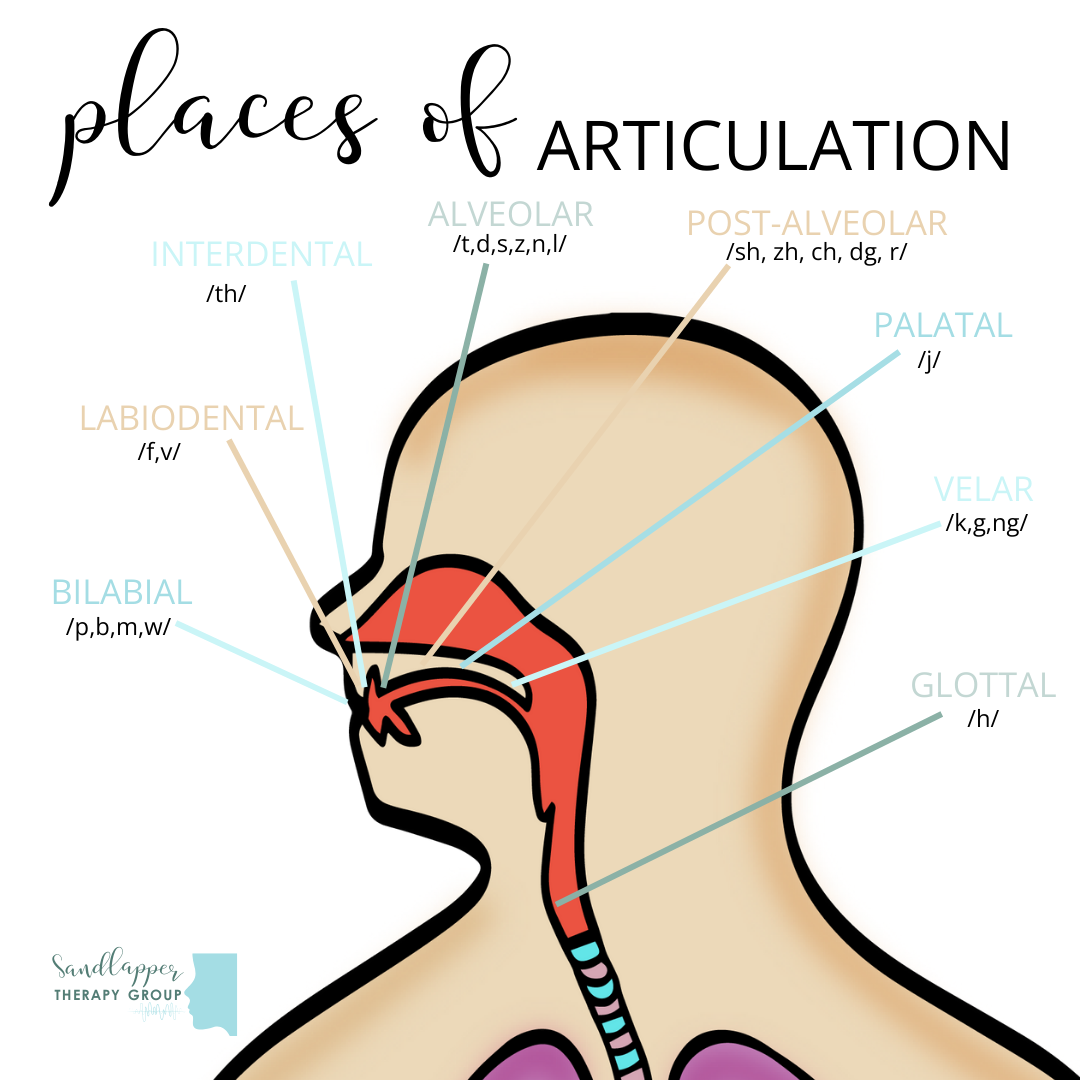
Place of articulation refers to where airflow is restricted or shaped in the vocal tract to produce a sound.
Speech-language pathologists use this framework when assessing articulation disorders and planning therapy. According to the American Speech-Language-Hearing Association (ASHA), speech sound production involves coordinated movement of the lips, tongue, teeth, palate, and vocal folds.
Learn more from ASHA here:
👉 https://www.asha.org/public/speech/disorders/speech-sound-disorders/
Below is a breakdown of the major places of articulation in English.
Bilabial Sounds
Both lips come together
Sounds:
/p, b, m, w/
Examples:
pop
baby
mom
These are some of the earliest developing sounds and are typically mastered by age 2–3.
Labiodental Sounds
Top teeth touch the bottom lip
Sounds:
/f, v/
Examples:
fish
van
Children often substitute /b/ or /p/ for /f/ in early development.
Interdental Sounds
Tongue placed between the teeth
Sound:
/th/ (voiced as in this and voiceless as in thumb)
These are later-developing sounds, typically mastered between ages 5–7.
Alveolar Sounds
Tongue touches the alveolar ridge (the bumpy ridge behind the top teeth)
Sounds:
/t, d, s, z, n, l/
Examples:
top
sun
nose
These sounds are common targets in speech therapy when children demonstrate “fronting” or “stopping” sound patterns.
Post-Alveolar Sounds
Tongue positioned slightly behind the alveolar ridge
Sounds:
/sh, zh, ch, dg, r/
Examples:
shoe
chair
judge
red
These sounds require more precise tongue placement and often develop later.
Palatal Sounds
Middle of the tongue touches the hard palate
Sound:
/j/ (as in yes)
Velar Sounds
Back of the tongue touches the soft palate (velum)
Sounds:
/k, g, ng/
Examples:
cat
go
sing
Children who substitute /t/ for /k/ (saying “tat” for “cat”) may be demonstrating a phonological process called fronting.
Glottal Sounds
Produced at the vocal folds (glottis)
Sound:
/h/
Examples:
hat
Why Places of Articulation Matter
Understanding where sounds are produced helps speech-language pathologists:
Identify patterns of errors
Differentiate articulation vs. phonological disorders
Develop targeted therapy plans
Teach correct tongue and lip placement
ASHA’s Practice Portal provides detailed clinical guidance for articulation and phonological assessment and intervention:
👉 https://www.asha.org/practice-portal/clinical-topics/articulation-and-phonology/
Common Speech Sound Error Patterns
Children do not simply “mispronounce” words randomly. Errors often follow predictable patterns tied to place of articulation.
For example:
Fronting: “tat” for “cat” (velar → alveolar)
Stopping: “tun” for “sun” (fricative → stop)
Gliding: “wabbit” for “rabbit”
Research supports pattern-based intervention approaches (Gierut, 2001) to address phonological errors efficiently and effectively.
Evidence-Based Speech Therapy
Speech-language pathologists use research-supported treatment methods such as:
Motor-based articulation therapy guided by motor learning principles (Maas et al., 2008)
Phonological contrast therapy for sound pattern errors
Cycles approach for children with multiple sound errors (Hodson, 2010)
Visual, tactile, and auditory cueing
A 2021 longitudinal study in the Journal of Speech, Language, and Hearing Research supports early intervention to improve speech intelligibility and prevent academic impact (Hustad et al., 2021).
When Should You Seek an Evaluation?
Consider a speech-language evaluation if your child:
Is difficult to understand compared to peers
Continues to substitute earlier sounds for later-developing ones
Shows frustration when speaking
Is frequently asked to repeat themselves
Early identification and intervention lead to stronger communication and academic outcomes.
The National Institute on Deafness and Other Communication Disorders (NIDCD) provides additional information about speech development:
👉 https://www.nidcd.nih.gov/health/speech-and-language
Final Thoughts
Speech sounds are produced in specific places in the mouth and throat. Understanding these places of articulation helps explain:
Why certain sounds develop earlier
Why some errors are typical
How speech therapy works
If you have concerns about your child’s speech sound development, a licensed speech-language pathologist can provide a comprehensive evaluation and individualized treatment plan.
Contact our office today to schedule a speech evaluation and support your child’s communication success.
References
American Speech-Language-Hearing Association (ASHA). (2024). Speech Sound Disorders Practice Portal. Retrieved from https://www.asha.org
Gierut, J. A. (2001). Complexity in phonological treatment. Journal of Speech, Language, and Hearing Research.
Hodson, B. W. (2010). Evaluating and Enhancing Children’s Phonological Systems.
Hustad, K. C., et al. (2021). Longitudinal growth in speech intelligibility in children. Journal of Speech, Language, and Hearing Research.
Maas, E., et al. (2008). Principles of motor learning in treatment of motor speech disorders. American Journal of Speech-Language Pathology.
National Institute on Deafness and Other Communication Disorders (NIDCD). (2023). Speech and Language Development. Retrieved from https://www.nidcd.nih.gov