
Asking Questions Development: When and How Children Learn to Ask Questions
One of the most exciting signs of language growth is when children begin asking questions. From “What’s that?” to “Why is he crying?” to “Are we going to the park tomorrow?”, question-asking shows that a child is developing vocabulary, grammar, reasoning, and social communication skills.
Understanding question development milestones can help parents know what is typical — and when to seek support from a speech-language pathologist.
Why Question Development Matters
When children learn to ask questions, they are developing:
Sentence structure (syntax)
Grammar (auxiliary verbs, pronouns, inversion)
Vocabulary
Social communication skills
Cognitive reasoning
The American Speech-Language-Hearing Association (ASHA) emphasizes that expressive language skills, including question formation, are essential for academic success and peer interaction.
Learn more here:
👉 https://www.asha.org/public/speech/development/language/
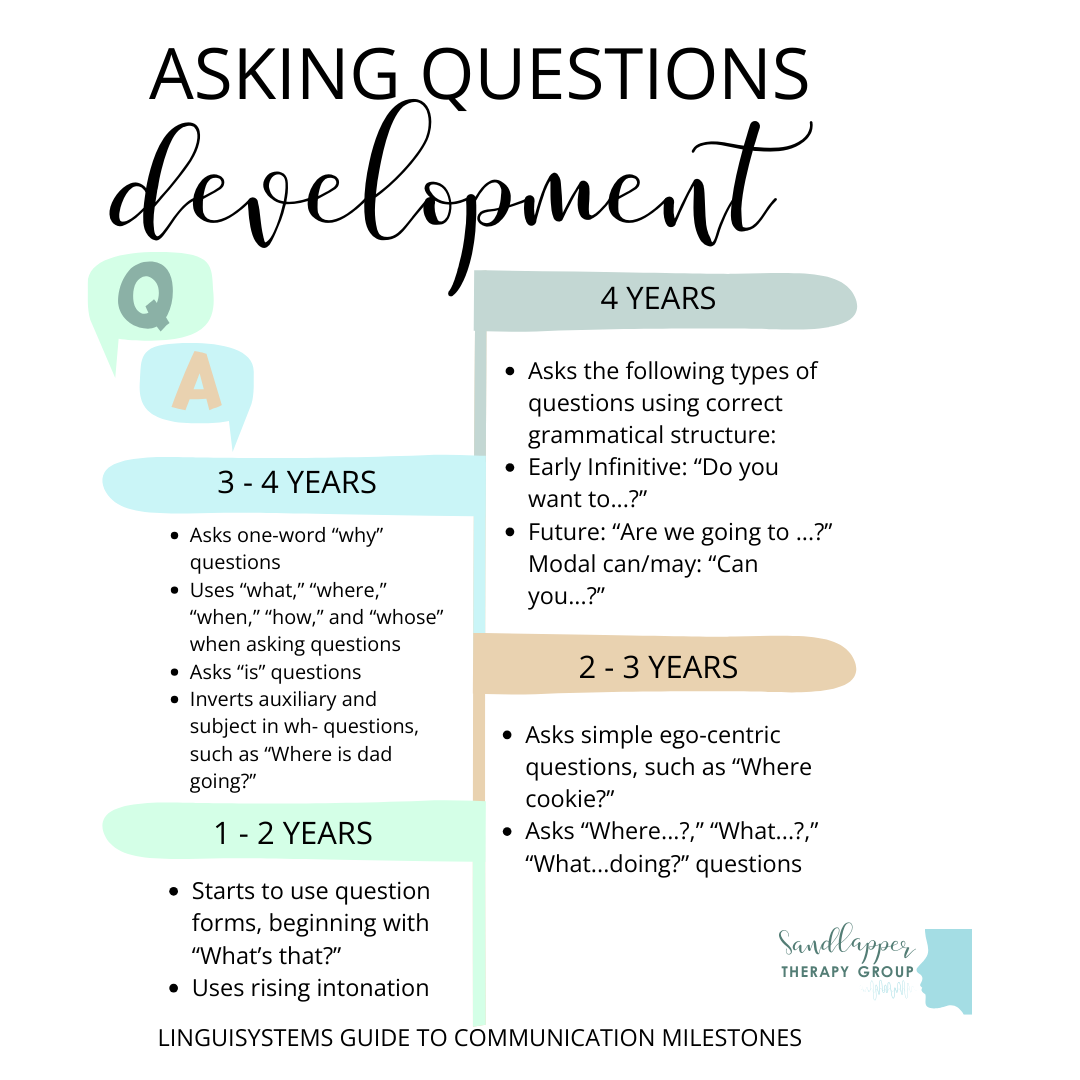
Question Development Milestones by Age
1–2 Years
During the second year of life, children begin experimenting with question forms.
Typical skills:
Uses rising intonation to indicate a question
Begins asking simple questions like:
“What’s that?”
At this stage, children may not yet use full grammatical structure but show early awareness that questions request information.
2–3 Years
Between 24 and 36 months, children begin asking more purposeful and specific questions.
Typical skills:
Asks simple, egocentric questions (e.g., “Where cookie?”)
Uses “Where…?” and “What…?”
Asks “What…doing?” questions
Examples:
“Where Mommy?”
“What that?”
“What he doing?”
These early questions often lack full grammatical structure but reflect growing expressive language skills.
ASHA describes this period as a time of rapid grammar expansion and early sentence formation.
👉 https://www.asha.org/practice-portal/clinical-topics/spoken-language-disorders/
3–4 Years
Between 36 and 48 months, children begin forming more grammatically complete questions.
Typical skills:
Asks one-word “why” questions
Uses “what,” “where,” “when,” “how,” and “whose”
Asks “is” questions
Inverts auxiliary and subject in WH-questions
Examples:
“Why?”
“Where is dad going?”
“How does it work?”
This stage reflects more advanced syntactic development, including correct word order in questions.
4 Years and Beyond
By age 4, children begin asking more complex questions using correct grammatical structure.
Typical skills:
Uses early infinitive forms:
“Do you want to…?”
Asks future-oriented questions:
“Are we going to…?”
Uses modal verbs:
“Can you…?”
“May I…?”
At this age, children demonstrate more complete subject-auxiliary inversion (e.g., “Is he going?” rather than “He is going?”).
According to research on syntactic development (Brown, 1973), mastery of question formation requires understanding auxiliary verbs, word order, and abstract language concepts.
Why Question Development Is Important for School
By preschool and kindergarten, children are expected to:
Ask and answer who, what, where, when, why, and how questions
Clarify when they don’t understand
Participate in classroom discussions
Request help appropriately
The CDC’s “Learn the Signs. Act Early.” initiative encourages parents to seek early support when language milestones are not being met:
👉 https://www.cdc.gov/ncbddd/actearly
Strong question-asking skills are also linked to literacy development, comprehension, and critical thinking.
The National Institute on Deafness and Other Communication Disorders (NIDCD) highlights the importance of early language development for academic readiness:
👉 https://www.nidcd.nih.gov/health/speech-and-language
When to Be Concerned
Consider a speech-language evaluation if your child:
Rarely asks questions
Uses limited question forms compared to peers
Does not use question words (who, what, where, why) by age 3–4
Struggles with word order in questions after age 4
Avoids conversational exchanges
Difficulties with question formation may indicate expressive language delay, syntactic weakness, or broader language disorder.
Evidence-Based Intervention for Question Development
Speech therapy targeting question development may include:
Modeling and recasting correct question forms
Structured practice of WH-question types
Expansion of auxiliary verbs
Play-based conversational modeling
Parent coaching for carryover
Research supports naturalistic language intervention approaches, including Enhanced Milieu Teaching (EMT) and parent-implemented interventions (Roberts & Kaiser, 2011).
Early intervention significantly improves expressive language and syntactic development.
Final Thoughts
Question development follows a predictable pattern:
1–2 years: “What’s that?”
2–3 years: “Where Mommy?”
3–4 years: “Where is dad going?”
4+ years: “Are we going to the park?”
If your child’s question-asking skills seem limited or delayed, early support can make a meaningful difference in communication confidence and school readiness.
If you have concerns about your child’s language development, contact our office today to schedule a comprehensive speech-language evaluation.
References
American Speech-Language-Hearing Association (ASHA). (2024). Spoken Language Disorders Practice Portal. Retrieved from https://www.asha.org
Brown, R. (1973). A First Language: The Early Stages. Harvard University Press.
Centers for Disease Control and Prevention (CDC). (2023). Learn the Signs. Act Early. Retrieved from https://www.cdc.gov/ncbddd/actearly
National Institute on Deafness and Other Communication Disorders (NIDCD). (2023). Speech and Language Development. Retrieved from https://www.nidcd.nih.gov
Roberts, M. Y., & Kaiser, A. P. (2011). The effectiveness of parent-implemented language interventions. American Journal of Speech-Language Pathology.