
Developmental Milestones: Understanding Averages vs. Milestones
When parents look at developmental charts, one of the most confusing parts is the difference between “average” ages and “milestone” ages.
You may see language like:
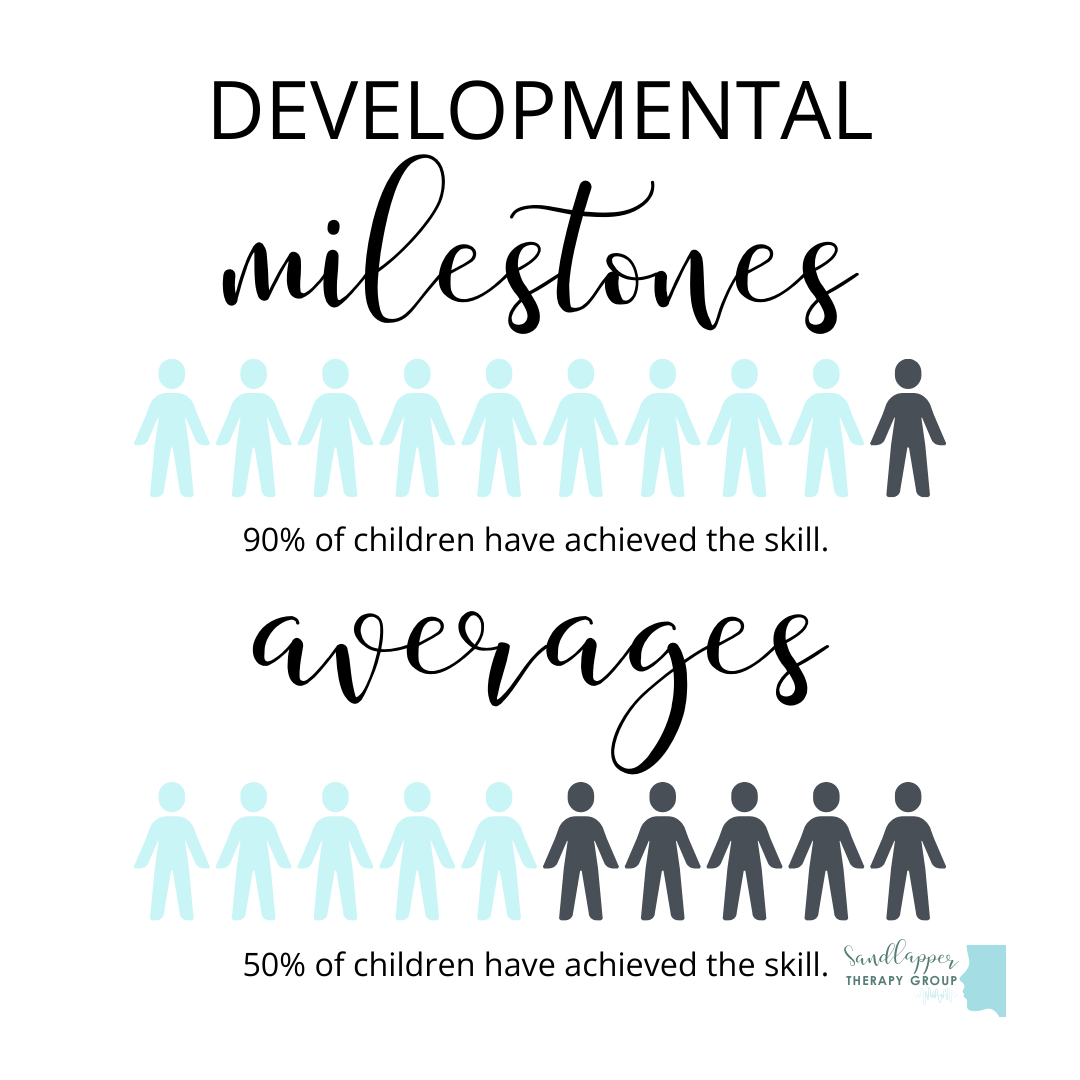
50% of children have achieved the skill
90% of children have achieved the skill
What does that actually mean? And when should you be concerned?
As a pediatric speech therapy practice, we want families to feel confident interpreting developmental information — not overwhelmed by it.
What Is a Developmental Milestone?
A developmental milestone is a skill most children achieve by a certain age. These skills may include:
First words
Combining words
Following directions
Producing speech sounds
Answering questions
Using complete sentences
According to the Centers for Disease Control and Prevention (CDC), milestones represent skills that most children can do by a certain age — not the earliest age some children may demonstrate the skill.
Learn more here:
👉 https://www.cdc.gov/ncbddd/actearly
90% Milestones: What They Mean
When a chart says:
90% of children have achieved the skill
It means that 9 out of 10 children can perform that skill by that age.
If a child has not met a 90% milestone, it may signal the need for closer monitoring or a professional evaluation.
The CDC recently updated its milestone guidelines to reflect this 75–90% standard to improve early identification of developmental delays.
50% Averages: What They Mean
When a chart says:
50% of children have achieved the skill
It means half of children have reached that skill by that age — and half have not yet.
This is considered the average age of acquisition.
For example:
Some children may say their first words at 10 months.
Others may begin closer to 14 months.
Both may fall within typical development, depending on the full developmental picture.
Why the Difference Matters
Understanding the difference between average (50%) and milestone (90%) helps parents avoid unnecessary worry — while also recognizing when support may be beneficial.
A child who hasn’t reached the average age for a skill may still be developing typically.
However, a child who has not reached a 90% milestone often benefits from further evaluation.
The American Speech-Language-Hearing Association (ASHA) emphasizes that early identification and intervention significantly improve long-term language outcomes.
Learn more here:
👉 https://www.asha.org/public/speech/development/
Why Early Identification Is Important
Research consistently shows that early intervention:
Improves communication skills
Reduces long-term academic challenges
Supports social development
Strengthens parent-child interaction
The National Institute on Deafness and Other Communication Disorders (NIDCD) notes that early speech and language delays can impact reading, writing, and academic success if left untreated.
👉 https://www.nidcd.nih.gov/health/speech-and-language
Children do not “outgrow” all delays. Monitoring milestones helps ensure timely support when needed.
Red Flags vs. Normal Variation
It’s important to look at the whole child, not just one skill.
Consider an evaluation if your child:
Is missing multiple milestones
Is significantly behind peers
Shows regression (loses previously acquired skills)
Has difficulty understanding language
Is frequently frustrated when communicating
A comprehensive speech-language evaluation looks at:
Receptive language
Expressive language
Speech sound development
Social communication
Play skills
What Parents Can Do
Track milestones regularly.
Trust your instincts.
Seek professional guidance if unsure.
Remember that early support is never harmful — but delayed support can be.
The CDC’s “Learn the Signs. Act Early.” program provides free milestone checklists for parents.
👉 https://www.cdc.gov/ncbddd/actearly
Final Thoughts
Developmental charts can feel intimidating — but understanding the difference between:
50% (average)
90% (milestone)
helps parents interpret them correctly.
If your child hasn’t met an average yet, it may simply reflect normal variation.
If your child hasn’t met a 90% milestone, early evaluation by a speech-language pathologist can provide clarity and peace of mind.
If you have concerns about your child’s speech or language development, contact our office today to schedule a comprehensive evaluation.
References
American Speech-Language-Hearing Association (ASHA). (2024). Speech and Language Development. Retrieved from https://www.asha.org
Centers for Disease Control and Prevention (CDC). (2023). Learn the Signs. Act Early. Retrieved from https://www.cdc.gov/ncbddd/actearly
National Institute on Deafness and Other Communication Disorders (NIDCD). (2023). Speech and Language Development. Retrieved from https://www.nidcd.nih.gov
Zubler, J. M., et al. (2022). Evidence-informed milestones for developmental surveillance tools. Pediatrics