
Expressive Vocabulary Milestones: What to Expect from 12–36 Months
One of the most exciting parts of early childhood development is hearing your child say new words. Expressive vocabulary — the words a child can say independently — grows rapidly between ages 1 and 3.
If you’re wondering whether your toddler’s speech is on track, this guide outlines typical expressive vocabulary milestones and when to consider a speech-language evaluation.
What Is Expressive Vocabulary?
Expressive vocabulary refers to the words a child can use independently to communicate wants, needs, and ideas.
According to the American Speech-Language-Hearing Association (ASHA), vocabulary growth during the first three years of life is one of the strongest predictors of later language, literacy, and academic success.
Learn more here:
👉 https://www.asha.org/public/speech/development/language/
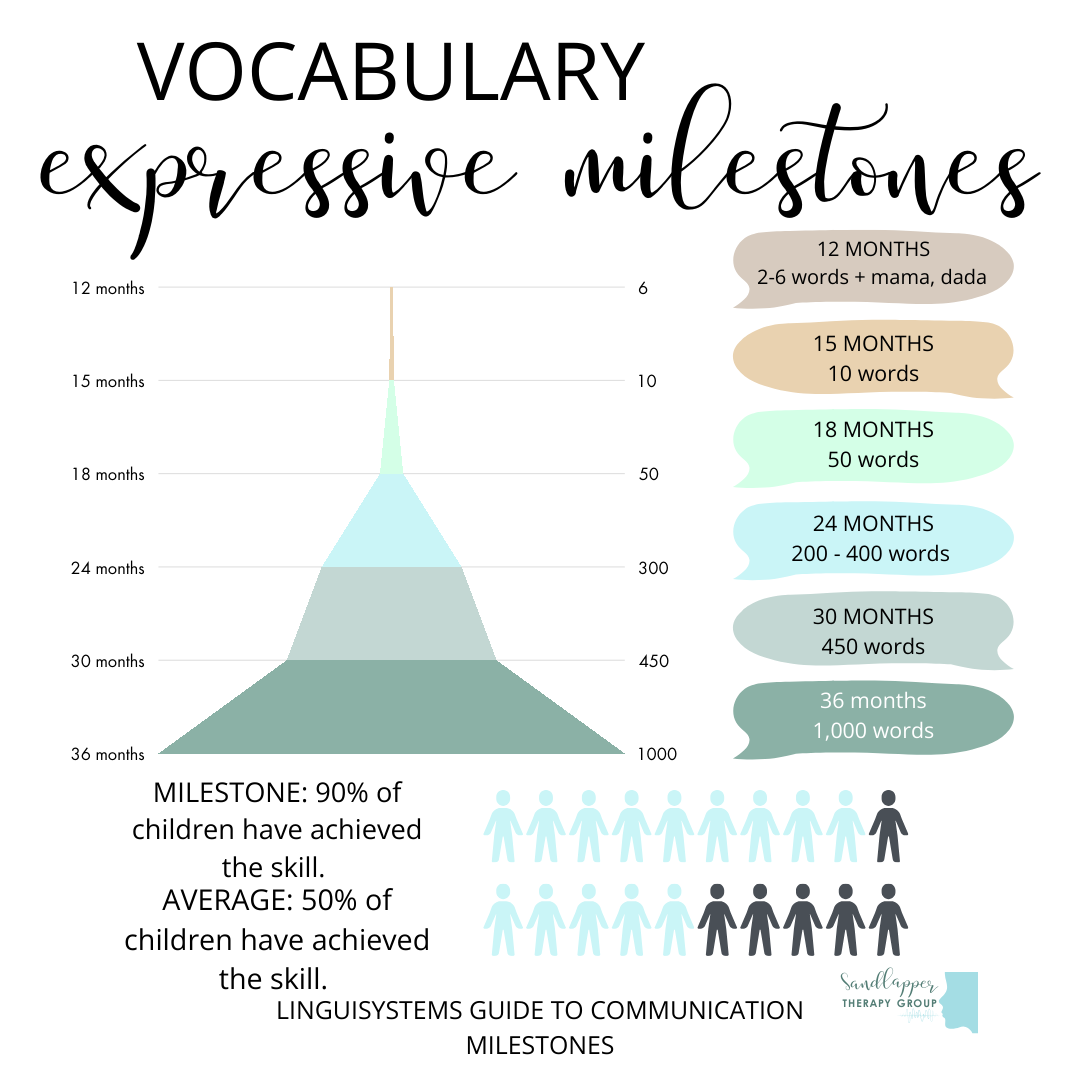
Expressive Vocabulary Milestones by Age
The milestones below represent typical developmental expectations. Individual children vary, but consistent delays may indicate the need for evaluation.
12 Months
2–6 words, in addition to “mama” and “dada”
Examples:
ball
bye
dog
milk
At this stage, words may not be perfectly clear but should be used consistently and meaningfully.
15 Months
Around 10 words
Children begin labeling familiar objects and people. Vocabulary growth is steady but gradual.
18 Months
Around 50 words
This is often considered a key milestone. Around 18 months, many toddlers experience a “vocabulary burst.”
Words may include:
nouns (dog, car)
action words (go, eat)
social words (hi, more)
The CDC’s Learn the Signs. Act Early. program identifies around 50 words as an important milestone by 18 months:
👉 https://www.cdc.gov/ncbddd/actearly
24 Months (2 Years)
200–400 words
By age 2, vocabulary expands rapidly. Children also begin combining words into two-word phrases such as:
“More juice”
“Mommy go”
“Big truck”
ASHA notes that by age 2, toddlers should be using simple word combinations regularly.
👉 https://www.asha.org/practice-portal/clinical-topics/spoken-language-disorders/
30 Months
Approximately 450 words
Children begin using more varied vocabulary, including:
Descriptive words
Action words
Question words
Early pronouns
Sentence length increases as vocabulary grows.
36 Months (3 Years)
Around 1,000 words
By age 3, children typically:
Speak in 3–4 word sentences
Use a wide variety of nouns, verbs, and descriptors
Ask questions
Tell simple stories
A vocabulary of approximately 1,000 words supports preschool readiness and social communication.
Understanding Milestone vs. Average
Vocabulary charts often include:
Milestone (90%): 90% of children have achieved this skill.
Average (50%): 50% of children have achieved this skill.
If your child is significantly below milestone expectations, it may be time to seek guidance.
Why Vocabulary Growth Matters
Strong expressive vocabulary supports:
Sentence development
Reading readiness
Social interaction
Following directions
Emotional expression
The National Institute on Deafness and Other Communication Disorders (NIDCD) emphasizes that early vocabulary growth strongly predicts later academic performance.
👉 https://www.nidcd.nih.gov/health/speech-and-language
Research shows that early language delays can impact literacy development if left untreated.
Signs Your Child May Need Support
Consider a speech-language evaluation if your child:
Has fewer than 10 words by 18 months
Has fewer than 50 words by 24 months
Is not combining words by age 2
Relies heavily on gestures instead of words
Shows frustration when trying to communicate
Early language delays are common and highly treatable with early intervention.
Evidence-Based Vocabulary Intervention
Speech therapy for expressive vocabulary may include:
Play-based language modeling
Parent coaching and daily routines
Focused stimulation
Expansion and recasting
Interactive book reading
Research supports caregiver-implemented language interventions for improving vocabulary outcomes (Roberts & Kaiser, 2011).
Early intervention significantly improves long-term communication and academic success.
Final Thoughts
Expressive vocabulary growth follows a predictable pattern:
12 months: 2–6 words
15 months: ~10 words
18 months: ~50 words
24 months: 200–400 words
30 months: ~450 words
36 months: ~1,000 words
If your child’s vocabulary seems limited compared to peers, early speech-language support can make a meaningful difference.
If you have concerns about your child’s speech or language development, contact our office today to schedule a comprehensive evaluation.
References
American Speech-Language-Hearing Association (ASHA). (2024). Language Development Milestones. Retrieved from https://www.asha.org
Centers for Disease Control and Prevention (CDC). (2023). Learn the Signs. Act Early. Retrieved from https://www.cdc.gov/ncbddd/actearly
National Institute on Deafness and Other Communication Disorders (NIDCD). (2023). Speech and Language Development. Retrieved from https://www.nidcd.nih.gov
Roberts, M. Y., & Kaiser, A. P. (2011). The effectiveness of parent-implemented language interventions. American Journal of Speech-Language Pathology.