
Areas of Speech-Language Pathology: How Speech Therapy Supports the Whole Child
When most people think of speech therapy, they think of helping a child say their sounds correctly. While articulation is certainly one part of what we do, speech-language pathology (SLP) covers much more.
Speech-language pathologists are trained to assess and treat a wide range of communication and related disorders across the lifespan. According to the American Speech-Language-Hearing Association (ASHA), SLPs work with individuals who have challenges with speech, language, voice, fluency, cognitive communication, social communication, and swallowing (ASHA, 2024).
If you’re wondering whether speech therapy might help your child, here’s a closer look at the major areas of speech-language pathology.
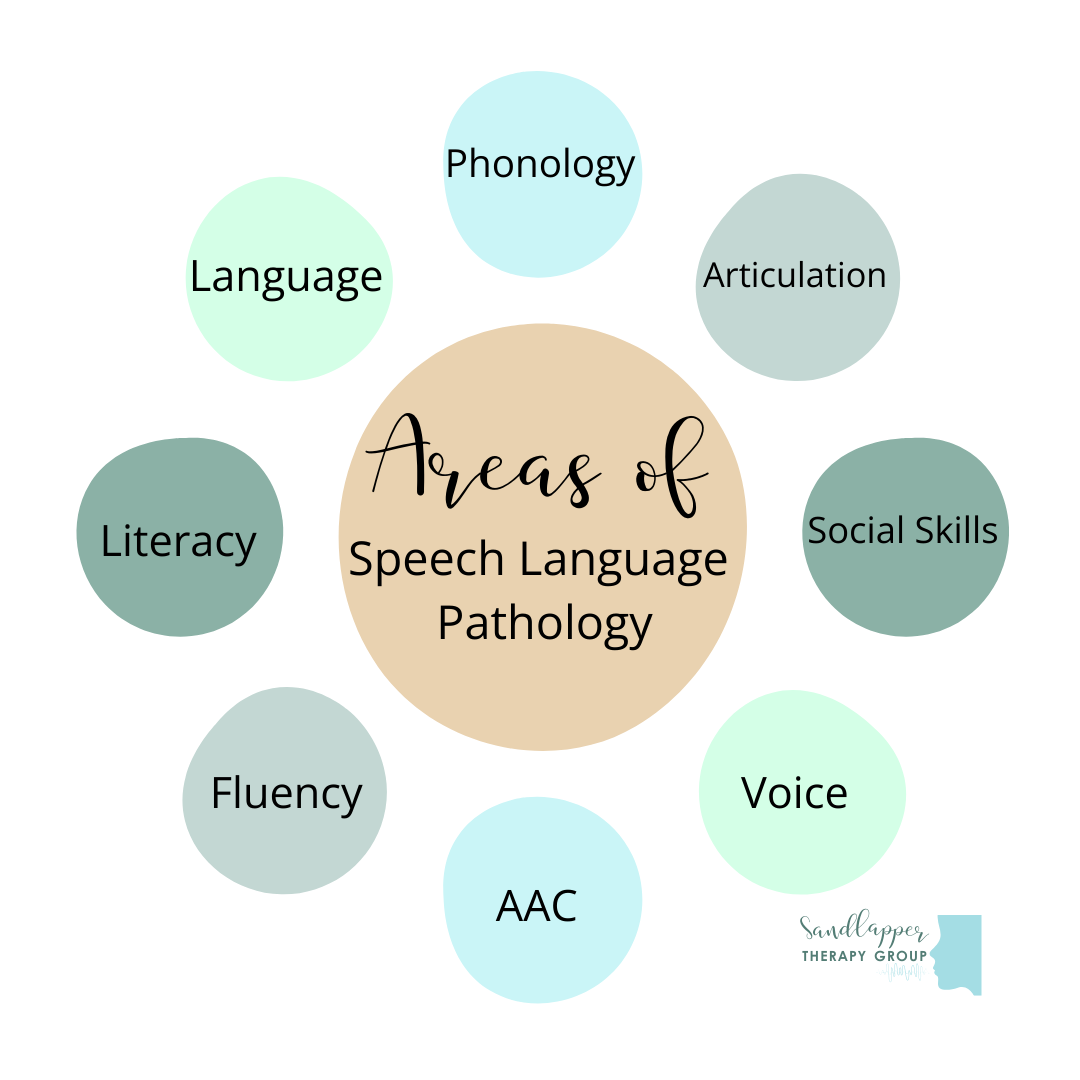
1. Language
Language refers to the system of words and symbols (spoken, written, or signed) used to communicate meaning.
Language skills include:
Receptive language – understanding words, directions, and questions
Expressive language – using words, sentences, gestures, or signs to communicate
Grammar and sentence structure
Vocabulary development
Storytelling and narrative skills
Children with language delays may struggle to follow directions, answer questions, or form complete sentences.
According to the CDC, early language delays can impact later reading, academic performance, and social development if not addressed (CDC, 2023). Early intervention has strong research support for improving outcomes.
Learn more about language development from:
ASHA: https://www.asha.org/public/speech/development/language/
CDC Developmental Milestones: https://www.cdc.gov/ncbddd/actearly
2. Phonology
Phonology refers to the patterns of sounds in a language. While articulation focuses on individual sounds, phonology addresses sound rule systems.
For example:
Saying “tat” for “cat” (fronting)
Saying “pane” for “plane” (cluster reduction)
These are called phonological processes and are typical at certain ages but should disappear as children develop.
Research published in the Journal of Speech, Language, and Hearing Research supports the use of pattern-based intervention approaches for phonological disorders, which can improve intelligibility efficiently and systematically (Gierut, 2001; ASHA Evidence Maps).
3. Articulation
Articulation is the ability to physically produce speech sounds correctly using the tongue, lips, jaw, and breath.
Common articulation challenges include difficulty producing sounds like:
/r/
/s/
/l/
/th/
Articulation therapy often involves structured practice, auditory discrimination training, and motor-based approaches supported by motor learning research (Maas et al., 2008).
If your child is difficult to understand compared to peers, an articulation evaluation may be appropriate.
4. Social Skills (Pragmatic Language)
Communication is more than words—it’s also knowing how to use language appropriately in social situations.
Social communication skills include:
Taking turns in conversation
Staying on topic
Understanding body language and facial expressions
Interpreting sarcasm or figurative language
Adjusting language depending on the listener
Social communication challenges are common in children with autism spectrum disorder (ASD), ADHD, and other developmental differences.
ASHA outlines pragmatic language as a core domain within speech-language pathology practice (ASHA Practice Portal, 2024).
5. Fluency
Fluency refers to the flow and rhythm of speech.
A fluency disorder, such as stuttering, may include:
Repeating sounds or syllables
Prolonging sounds
Blocking (getting “stuck”)
Physical tension while speaking
According to the National Institute on Deafness and Other Communication Disorders (NIDCD), about 5–10% of children will stutter at some point, though many outgrow it. Early therapy significantly increases the likelihood of positive outcomes.
Evidence-based fluency interventions include fluency shaping and stuttering modification approaches (Yairi & Ambrose, 2013).
Learn more:
6. Voice
Voice disorders involve problems with pitch, loudness, or vocal quality.
Children with voice disorders may sound:
Hoarse
Breathy
Strained
Too loud or too quiet
Voice therapy may include vocal hygiene education, breath support training, and resonance therapy techniques. Research supports behavioral voice therapy as an effective first-line treatment for many pediatric voice disorders (ASHA Practice Portal, 2024).
7. Literacy
Speech and language skills form the foundation for reading and writing.
SLPs support literacy development through:
Phonological awareness training
Sound-letter correspondence
Narrative comprehension
Vocabulary development
Research consistently demonstrates a strong connection between early language skills and later reading success (Catts et al., 2002). Intervention targeting phonological awareness can significantly improve early reading outcomes.
8. AAC (Augmentative and Alternative Communication)
Augmentative and Alternative Communication (AAC) includes tools and strategies used to support or replace spoken language.
AAC may involve:
Picture communication systems
Communication boards
Speech-generating devices
iPad-based communication apps
AAC does not prevent speech development. In fact, research shows that AAC often supports and enhances verbal communication (Millar, Light, & Schlosser, 2006).
ASHA recognizes AAC as a core component of speech-language pathology services across ages and diagnoses.
Learn more:
ASHA AAC Overview: https://www.asha.org/public/speech/disorders/aac/
Why Comprehensive Evaluation Matters
Because communication is complex, challenges often overlap. A child may have both language and phonological difficulties, or fluency and social communication concerns.
A licensed speech-language pathologist provides:
Comprehensive evaluations
Individualized, evidence-based treatment plans
Parent coaching and home strategies
Collaboration with teachers and pediatricians
Early, targeted intervention leads to stronger long-term academic, social, and emotional outcomes.
When Should You Seek an Evaluation?
You may want to schedule a speech-language evaluation if your child:
Is difficult to understand
Is not meeting communication milestones
Has trouble following directions
Struggles socially with peers
Stutters
Has a hoarse or strained voice
Is behind in early reading skills
The earlier concerns are addressed, the better the outcomes.
Final Thoughts
Speech-language pathology is about much more than pronunciation. It encompasses:
Language
Phonology
Articulation
Social communication
Fluency
Voice
Literacy
AAC
If you have questions about your child’s communication development, we’re here to help. Contact our office today to schedule a comprehensive evaluation and learn how speech therapy can support your child’s growth and confidence.
References
American Speech-Language-Hearing Association (ASHA). (2024). Practice Portal. Retrieved from https://www.asha.org
American Speech-Language-Hearing Association (ASHA). (2024). Augmentative and Alternative Communication (AAC). Retrieved from https://www.asha.org/public/speech/disorders/aac/
Catts, H. W., Fey, M. E., Tomblin, J. B., & Zhang, X. (2002). A longitudinal investigation of reading outcomes in children with language impairments. Journal of Speech, Language, and Hearing Research.
Centers for Disease Control and Prevention (CDC). (2023). Learn the Signs. Act Early. Retrieved from https://www.cdc.gov/ncbddd/actearly
Gierut, J. A. (2001). Complexity in phonological treatment. Journal of Speech, Language, and Hearing Research.
Maas, E., et al. (2008). Principles of motor learning in treatment of motor speech disorders. American Journal of Speech-Language Pathology.
Millar, D. C., Light, J. C., & Schlosser, R. W. (2006). The impact of AAC intervention on speech production: A research review. Journal of Speech, Language, and Hearing Research.
National Institute on Deafness and Other Communication Disorders (NIDCD). (2023). Stuttering. Retrieved from https://www.nidcd.nih.gov/health/stuttering
Yairi, E., & Ambrose, N. (2013). Epidemiology of stuttering. Journal of Fluency Disorders.