
Understanding the Language Processing Hierarchy
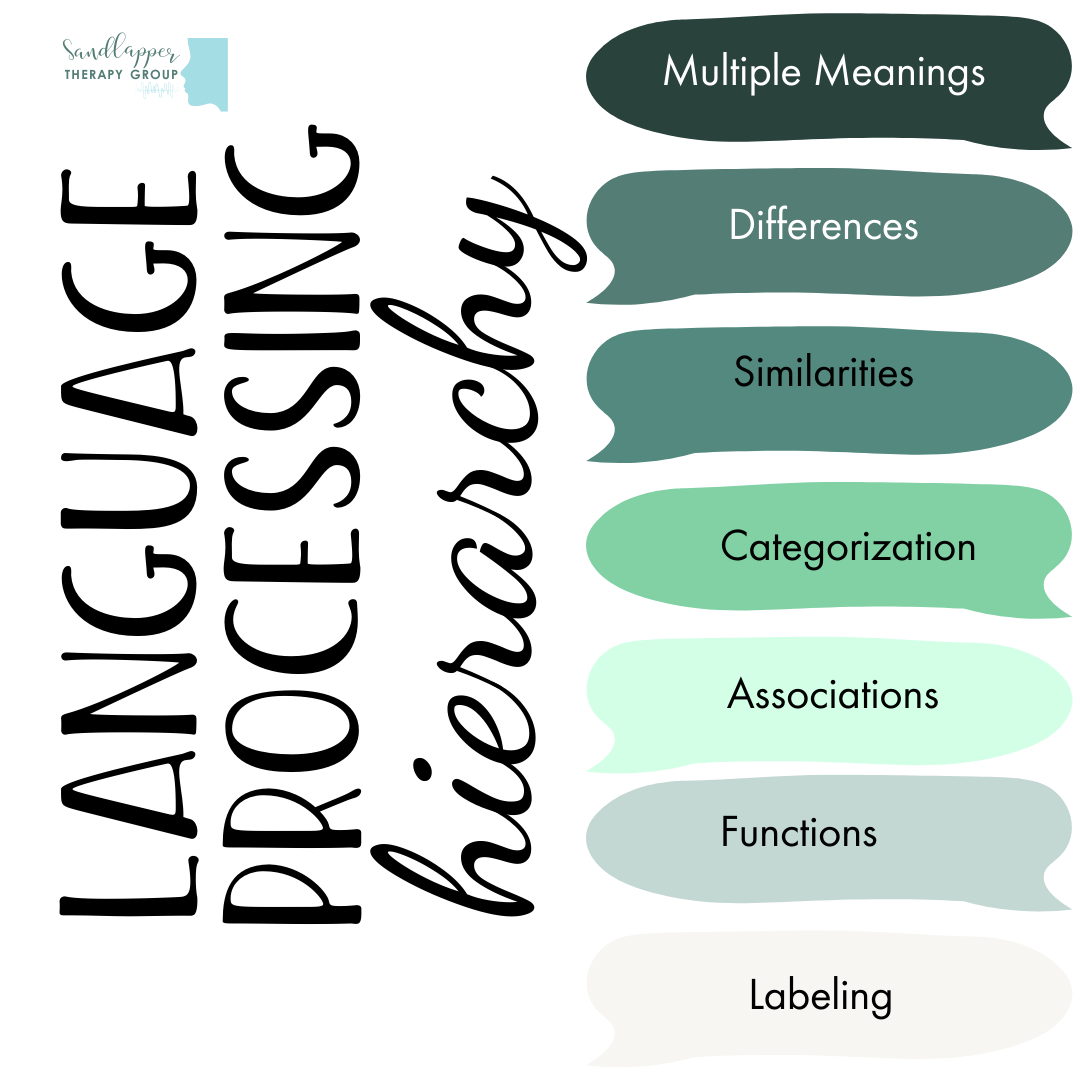
How Language Skills Build From the Ground Up
Understanding the Language Processing Hierarchy: How Language Skills Build from the Ground Up.
When families begin speech therapy, one of the most common questions we hear is:
“Why is my child working on these skills instead of just talking more?”
The answer lies in the Language Processing Hierarchy—a way of understanding how the brain organizes language. Language development is not a single skill; it is a layered process. Each level supports the next, and strong communication depends on having a solid foundation.
At Sandlapper Therapy Group, this hierarchy helps guide how we assess, plan, and support your child’s progress.
Language Processing Starts With Meaning — Not Just Words
Before children can use language easily and effectively, they must first understand and organize meaning. Let’s walk through each level of the hierarchy, starting from the foundation.
1. Labeling
This is the most basic level of language—naming objects, actions, and people.
Examples include:
Naming common items (dog, car, spoon)
Naming actions (run, eat, jump)
Identifying familiar people or places
Labeling is important, but it is only the beginning. Knowing a word does not mean a child fully understands how to use it.
2. Functions
Next, children learn what things are used for.
Examples include:
“You eat with a spoon.”
“A bed is for sleeping.”
“Shoes are for your feet.”
Understanding function shows deeper comprehension and helps children apply language meaningfully in daily life.
3. Associations
At this level, children begin making connections between ideas.
Examples include:
Dog → bone
Birthday → cake
Rain → umbrella
Associations help children organize vocabulary in their brain, which supports comprehension, memory, and expressive language.
4. Categorization
Here, children learn how items belong together.
Examples include:
Fruits vs. vegetables
Animals vs. vehicles
Things you wear vs. things you eat
Categorization strengthens word retrieval and helps children describe, compare, and explain ideas more clearly.
5. Similarities
This level focuses on how things are alike.
Examples include:
“A cat and a dog are both animals.”
“A fork and spoon are both utensils.”
Understanding similarities supports abstract thinking and is essential for academic language and problem-solving.
6. Differences
Children then learn how things are different.
Examples include:
“A cat meows, but a dog barks.”
“A pencil is for writing; scissors are for cutting.”
This skill is critical for describing, explaining, and answering “why” and “how” questions.
7. Multiple Meanings
At the top of the hierarchy is understanding that words can have more than one meaning.
Examples include:
Bat (animal vs. baseball bat)
Bank (money vs. river bank)
Light (not heavy vs. not dark)
This is a higher-level language skill that supports reading comprehension, classroom learning, and social communication.
Why Therapy Often Starts “Lower” on the Hierarchy
If a child struggles with higher-level language skills, it is often because the foundation below needs strengthening. Therapy may focus on labeling, functions, or categorization—not because your child can’t talk, but because deeper understanding leads to clearer, more confident communication.
Think of language like building a house:
Strong walls and a roof depend on a solid foundation.
When the lower levels are secure, expressive language grows more easily and naturally.
What This Means for Your Child’s Therapy
Every child’s language profile is unique. Progress may look different at each stage, and growth is not always immediate or obvious. Improvements in understanding, organization, and meaning are powerful steps toward stronger communication.
At Sandlapper Therapy Group, our goal is not quick fixes—it’s lasting language development that supports your child at home, at school, and in everyday life.
If you ever have questions about your child’s goals or why therapy looks the way it does, we are always happy to talk. You are an important part of the therapy team.
References & Evidence-Based Foundations
The Language Processing Hierarchy used at Sandlapper Therapy Group is grounded in decades of research on how children understand, organize, and use language. The following sources inform this approach and support the importance of building foundational language skills before higher-level expression:
Bloom, L., & Lahey, M. (1978). Language Development and Language Disorders. New York, NY: John Wiley & Sons.
Foundational work describing how language form, content, and use develop together and depend on underlying comprehension and organization.
Owens, R. E. (2020). Language Development: An Introduction (10th ed.). Pearson Education.
A widely used graduate-level text explaining semantic development, categorization, word relationships, and higher-level language processing.
Paul, R., Norbury, C., & Gosse, C. (2018). Language Disorders from Infancy Through Adolescence (5th ed.). Elsevier.
Supports the hierarchical nature of language skills, including vocabulary development, semantic relationships, and abstract language.
ASHA – American Speech-Language-Hearing Association.
Spoken Language Disorders
Language in Brief
www.asha.orgASHA emphasizes that expressive language relies on intact receptive and semantic processing skills.
Nippold, M. A. (2016). Later Language Development: School-Age Children, Adolescents, and Young Adults (4th ed.). Pro-Ed.
Highlights development of multiple meanings, similarities/differences, and higher-level semantic reasoning.
Marzano, R. J. (2004). Building Background Knowledge for Academic Achievement. ASCD.
Supports the role of categorization, associations, and semantic networks in learning and comprehension.
A Note for Families
Language development is complex and deeply interconnected. Research consistently shows that strong foundational language skills support clearer speech, better comprehension, academic success, and confident communication. Therapy that builds language from the ground up leads to more meaningful and lasting progress.